
The accounting equation shows how everything a business owns is funded. It connects assets with liabilities and owners’ equity, helping businesses maintain accurate and balanced financial records. It serves as the foundation of double-entry accounting, ensuring that every financial transaction keeps the books in balance. The basic Formula is:
Assets = Liabilities + Equity
Every valid business transaction keeps this relationship balanced. When one account changes, at least one other account must change by an equal amount. This principle supports double-entry bookkeeping and the balance sheet.
| Key point | Explanation |
| Basic Formula | Assets = Liabilities + Equity |
| Assets | Resources the business owns or controls |
| Liabilities | Amounts the business owes |
| Equity | The owners’ remaining interest |
| Main purpose | To show how business resources are financed |
| Related statement | Balance sheet |
| Bookkeeping connection | Each transaction affects at least two accounts |
| Alternative form | Equity = Assets − Liabilities |
Direct answer: The accounting equation states that a business’s assets must equal its liabilities plus its owners’ equity. Assets show what the business controls, while liabilities and equity show where the funding came from. Every recorded transaction must preserve this balance, even when several individual accounts change.
Key Takeaways
- A business finances its assets through borrowing, owner investment, or retained profits.
- Equity represents the amount left after liabilities are deducted from assets.
- Revenue increases equity when it creates profit.
- Expenses and owner withdrawals reduce equity.
- A balanced formula doesn’t guarantee that every entry is correct.
- Transaction analysis helps you find recording mistakes before preparing financial statements.
What the Accounting Equation Means?

The Formula can be read as a simple funding statement:
Everything a business has comes from either creditors or its owners. Assets appear on the left side, while liabilities and equity appear on the right, and both sides must always have the same total. This balance ensures every transaction is properly recorded and helps businesses track where funds come from and how they are used.
Suppose a business has $40,000 in assets. It also owes lenders and suppliers $15,000. Its owners’ interest must be $25,000:
$40,000 = $15,000 + $25,000
The owners would theoretically have $25,000 left if the business sold its recorded assets at their recorded values and paid its recorded debts. Actual sale values may differ, so book equity isn’t always the same as market value.
The Three Parts of the Formula
Assets
Assets are resources that a business owns or controls and expects to use for economic benefit. They may be physical, financial, or intangible. Examples include cash, inventory, equipment, investments, patents, and trademarks. These resources help a company operate, generate revenue, and support future growth.
Common assets include:
- Cash
- Accounts receivable
- Inventory
- Equipment
- Vehicles
- Buildings
- Prepaid expenses
- Patents and trademarks
Assets may be current or non-current. Current assets are expected to be used, sold, or converted to cash within the normal operating cycle. Non-current assets usually support the business for longer periods. Examples of current assets include cash, inventory, and accounts receivable, while non-current assets include buildings, machinery, and long-term investments.
Liabilities
Liabilities are present obligations to other parties. They often require the business to pay cash, deliver goods, or provide services later. Common examples include loans, accounts payable, wages owed, and unpaid expenses. Managing liabilities helps businesses maintain healthy cash flow and meet their financial commitments.
Examples include:
- Bank loans
- Accounts payable
- Accrued wages
- Taxes payable
- Mortgages
- Deferred revenue
- Lease obligations
Liabilities help finance assets, but they also create future commitments. Looking only at total assets can therefore give an incomplete picture of financial position. Evaluating liabilities alongside assets helps measure a company’s financial health, debt levels, and ability to meet both short-term and long-term obligations.
Equity
Equity is the owners’ residual interest after liabilities are deducted from assets. It represents the value that belongs to the owners and includes investments, retained earnings, and accumulated profits or losses. Equity increases when the business earns profits or owners contribute additional capital, and it decreases when the business incurs losses or distributes dividends.
Equity = Assets − Liabilities
Equity may include owner contributions, share capital, and retained earnings. It falls when the business records losses, pays dividends, or makes owner withdrawals. The terminology depends on the business structure. A sole proprietor may use “owner’s capital.” A corporation may report “shareholders’ equity.” The underlying relationship remains the same.
How the Accounting Equation Stays Balanced?

Double-entry bookkeeping records each transaction in at least two accounts. The entries must produce equal debit and credit totals. That doesn’t mean every transaction changes both sides of the Formula. Some transactions change two asset accounts. Others increase one asset while increasing a liability or equity account.
The table below shows eight common transactions for a new design business.
| Transaction | Asset effect | Liability effect | Equity effect |
| Owner invests $10,000 cash | +$10,000 | — | +$10,000 |
| Business borrows $5,000 | +$5,000 | +$5,000 | — |
| Equipment bought for $3,000 cash | $3,000 equipment, −$3,000 cash | — | — |
| Supplies bought for $800 on credit | +$800 | +$800 | — |
| Service completed for $1,200 cash | +$1,200 | — | +$1,200 |
| Utility bill of $200 paid | −$200 | — | −$200 |
| Supplier paid $300 | −$300 | −$300 | — |
| Owner withdraws $500 | −$500 | — | −$500 |
Each row remains balanced. ACCA uses the same dual-effect principle when showing how loans, inventory purchases, sales, expenses, repayments, and drawings change financial records. Every transaction affects at least two accounts, ensuring that the accounting equation stays in balance after each entry.
1. Owner Investment
An owner deposits $10,000 into the business bank account.
Cash increases by $10,000. Owner’s capital also increases by $10,000:
Assets $10,000 = Liabilities $0 + Equity $10,000
The company now controls cash funded entirely by the owner.
2. Bank Loan
The business receives a $5,000 loan.
Cash rises by $5,000, while the loan liability rises by the same amount:
Assets $15,000 = Liabilities $5,000 + Equity $10,000
Borrowed cash is an asset, but the obligation to repay it is a liability.
3. Equipment Purchased With Cash
The business buys a computer and other equipment for $3,000.
Equipment rises by $3,000. Cash falls by $3,000. Total assets don’t change.
This transaction changes the composition of assets rather than their combined value.
4. Supplies Purchased on Credit
The business receives $800 of supplies and agrees to pay later.
Supplies increase by $800. Accounts payable also increases by $800.
Buying on credit creates both a resource and an obligation.
5. Cash Revenue Earned
The business completes a project and receives $1,200.
Cash increases by $1,200. Revenue increases profit, which raises equity by $1,200.
Revenue doesn’t appear as a permanent fourth part of the basic Formula. Its effect flows into equity through profit.
6. Expense Paid
The business pays a $200 electricity bill.
Cash decreases by $200. The expense reduces profit and therefore reduces equity by $200.
Expenses don’t always create liabilities. A liability arises only when the amount remains unpaid at the reporting date.
7. Amount Owed to a Supplier Is Paid
The business pays $300 toward accounts payable.
Cash falls by $300. The liability also falls by $300.
This payment doesn’t create an expense because the supplies and payable were recorded earlier.
8. Owner Withdrawal
The owner removes $500 for personal use.
Business cash decreases by $500. Equity also decreases because the withdrawal returns part of the owner’s interest.
A withdrawal isn’t a business operating expense. It should be recorded separately from costs incurred to earn revenue.
The Expanded Accounting Equation
The basic Formula can be expanded to show what changes equity. Equity increases through owner investments and profits, while it decreases through withdrawals, losses, and expenses. Understanding these changes helps businesses track their financial position over time.
For a sole proprietorship, a common version is:
Assets = Liabilities + Owner’s Capital + Revenue − Expenses − Drawings
For a corporation, it may be presented as:
Assets = Liabilities + Contributed Capital + Retained Earnings + Revenue − Expenses − Dividends
The expanded version helps students see why income, costs, and distributions affect the owners’ interest. ACCA expresses a similar relationship by adding income, subtracting expenses and drawings, and combining the result with introduced capital.
What Happens When the Formula Doesn’t Balance?
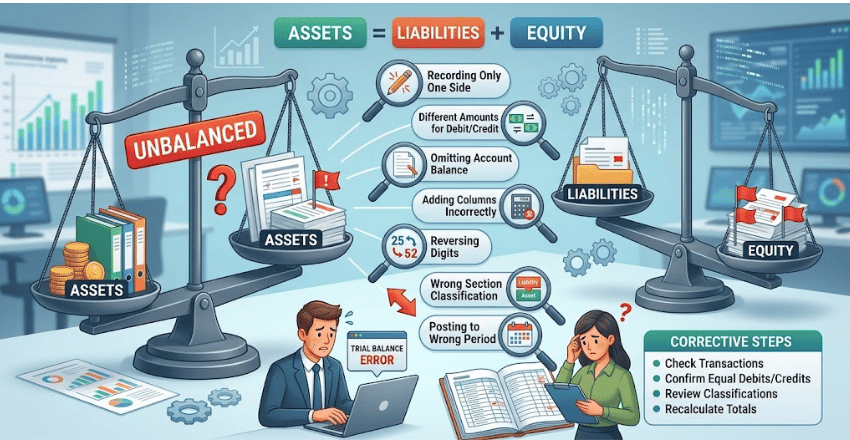
An unbalanced calculation usually signals a recording, classification, or arithmetic problem. Common causes include entering a transaction in only one account, using the wrong amount, or posting it to an incorrect account. Identifying and correcting these errors promptly helps maintain accurate financial statements and ensures the integrity of the accounting records.
Common causes include:
- Recording only one side of a transaction
- Entering different amounts for the debit and credit
- Omitting an account balance
- Adding a column incorrectly
- Reversing digits
- Placing a liability in the asset section
- Posting an entry to the wrong reporting period
Start by checking recent transactions. Confirm that each entry has equal debit and credit amounts. Then review account classifications and recalculate the totals. A trial balance can help identify unequal debits and credits. It can’t detect every mistake, though. Two equal but incorrect entries may still leave the books balanced.
What the Formula Can and Cannot Tell You
The accounting equation confirms that every asset a business records is financed by either liabilities or owners’ equity. This balance ensures that the value of everything the business owns is matched by the claims of creditors and owners, providing a complete picture of how the company’s resources are funded. This principle supports accurate bookkeeping, reliable financial reporting, and informed decision-making by managers, investors, and lenders.
It can help you:
- Understand a balance sheet
- Analyse transaction effects
- Calculate missing assets, liabilities, or equity
- Check whether entries preserve the required relationship
- See how borrowing affects a company’s financial structure
It cannot tell you whether a company is profitable, liquid, efficient, or fairly valued. A company may have balanced records while struggling to pay bills. It may also classify an entry incorrectly while keeping both sides equal. Investopedia likewise notes that a balanced statement doesn’t, by itself, show whether a business has an appropriate level of debt or sufficient assets. Readers still need to interpret the figures.
A Three-Question Transaction Check
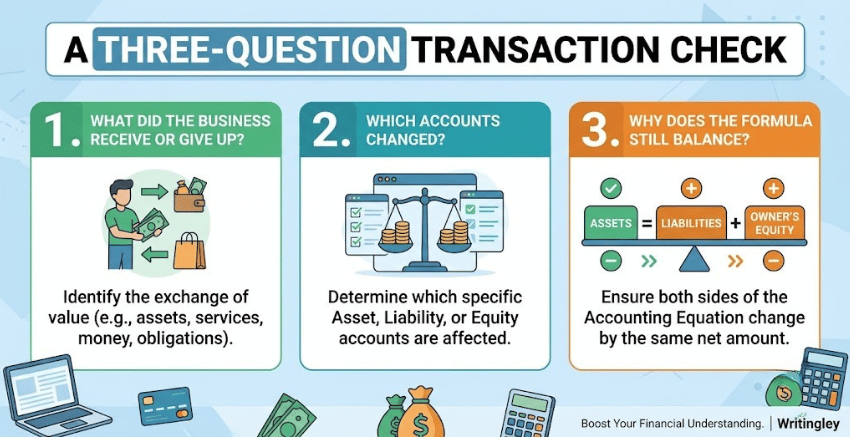
Use this framework before recording a transaction:
- What did the business receive or give up?
- Which accounts changed?
- Why does the Formula still balance?
For example, suppose the business buys a $2,000 laptop using a credit card.
It receives equipment, so assets rise by $2,000. It also takes on a card balance, so liabilities rise by $2,000. Both sides increase equally. This three-question check connects the business event to the accounts before you think about debit and credit rules.
If you are building your accounting knowledge, you may also find Writingley’s guides on the accounting equation, contribution margin formula, interest expense, and YOY (Year-over-Year) helpful. Together, these topics explain how financial transactions affect profitability, borrowing costs, and business reporting.
For broader money education, visit Writingley’s finance section. You can also use the site’s monthly savings calculator to see how financial formulas turn goals and time periods into practical figures. These pages were live when this article was prepared.
Use the Formula as a Daily Accuracy Check
Treat the Formula as more than a rule to memorise. Use it to explain where each resource came from and how each transaction changes the business.
When the numbers don’t balance, trace the recent entries and check both sides. When they do balance, continue reviewing account classifications and supporting documents. A balanced result is an essential first check, not the final proof that every record is correct.
Conclusion
The accounting equation is the foundation of financial accounting because it shows how every asset is financed through liabilities or owners’ equity. By keeping the equation balanced after every transaction, businesses can maintain accurate records, prepare reliable financial statements, and better understand their financial position.
Whether you are a business owner, student, or accounting professional, understanding this equation makes it easier to analyze transactions, identify recording errors, and interpret balance sheets with confidence. Regularly applying the accounting equation as a financial check helps ensure that accounting records remain complete, consistent, and ready for informed business decision-making.
If you want to know about High Yield Checking Account then visit our Finance category.