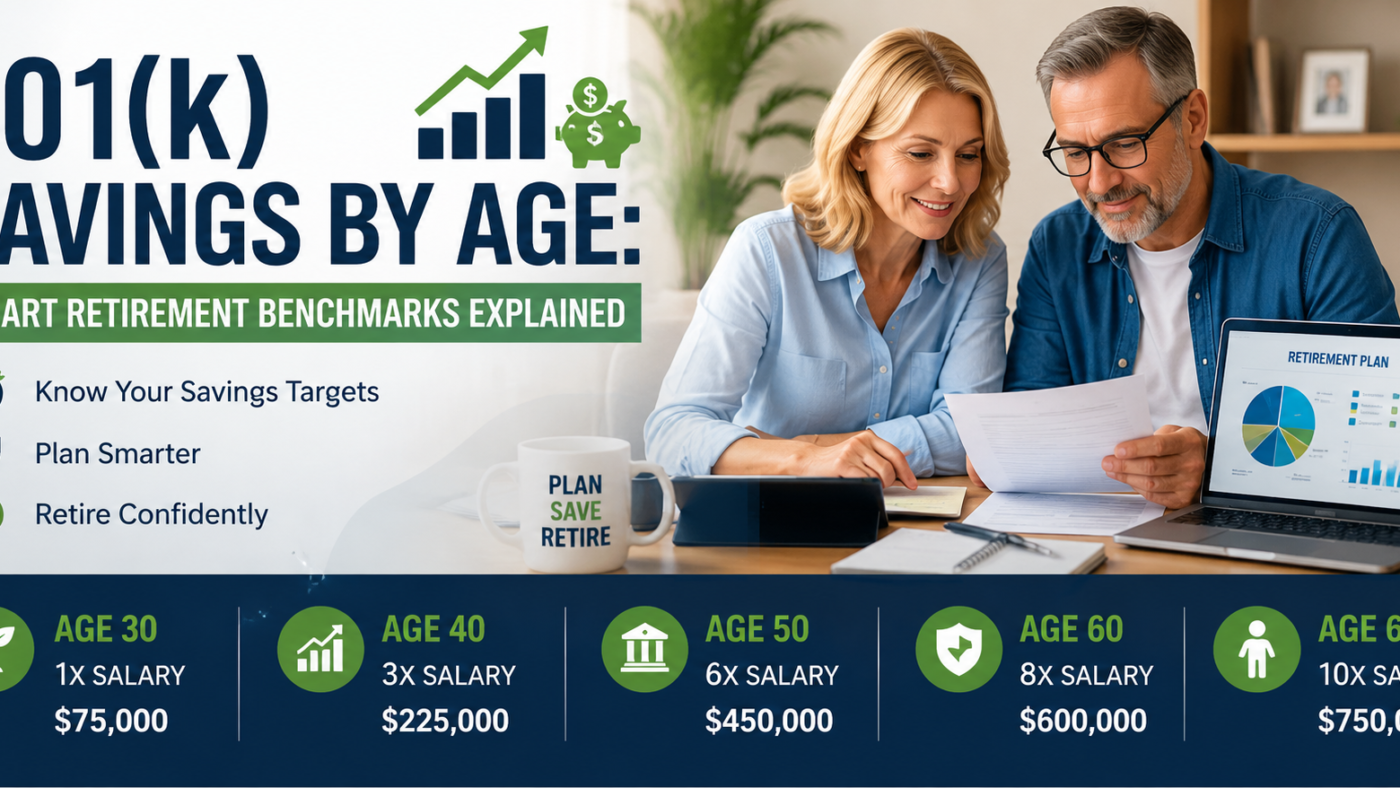
If you’re wondering how much should i have in my 401k a useful starting point is comparing your savings to your annual salary. Common retirement benchmarks suggest having about one year of income saved by age 30, three times your income by 40, six times by 50, eight times by 60, and ten times by 67.
These figures should guide your planning, not serve as a pass-or-fail test. A steady contribution rate and a realistic retirement plan matter more than matching another person’s account balance.
| Age | Suggested total retirement savings | Example on a $75,000 salary |
| 30 | 1× annual salary | $75,000 |
| 40 | 3× annual salary | $225,000 |
| 50 | 6× annual salary | $450,000 |
| 60 | 8× annual salary | $600,000 |
| 67 | 10× annual salary | $750,000 |
Direct answer: Aim for roughly one year of salary by age 30, three times your salary by 40, six times by 50, eight times by 60, and ten times by 67. Count all retirement accounts, not only your current workplace plan. Adjust the target for your retirement date, expected expenses, and other income.
How Much Should I Have in My 401 (k) by Age?
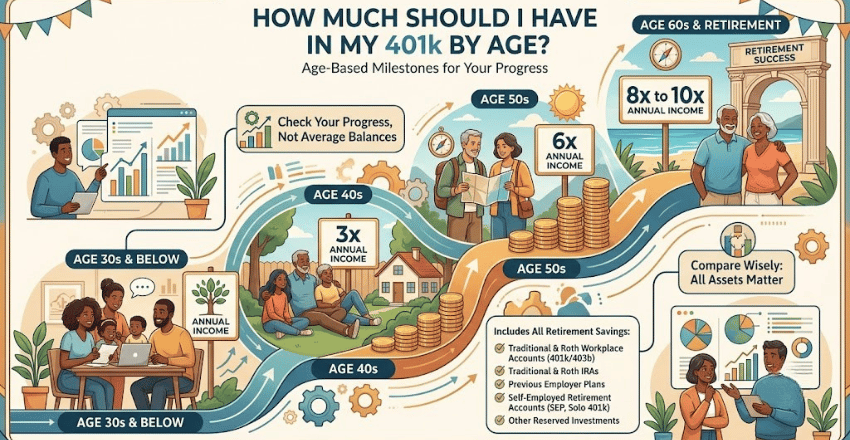
Age-based milestones provide a quick way to check your progress. They work better than average balances because they compare your savings with your income and likely standard of living.
These benchmarks usually include all money set aside for retirement. That may include:
- Traditional and Roth workplace accounts
- Traditional and Roth IRAs
- Previous employers’ retirement plans
- Self-employed retirement accounts
- Other investments specifically reserved for retirement
You shouldn’t compare your single workplace account with a benchmark that assumes all retirement assets are included.
In Your 20s
If you’re asking how much should i have in my 401k, remember that your biggest advantage is time. You may not have a large balance yet, especially if you recently entered the workforce or are paying down education debt. Focus first on contributing enough to receive your full employer match.
A reasonable next goal is to save 10% to 15% of gross income for retirement, including employer contributions. Fidelity’s guideline uses a 15% annual savings rate beginning at age 25 as one of the assumptions behind its salary-based milestones.
By Age 30
If you’re asking how much should I have in my 401k, a common target is one times your annual salary across your retirement accounts by age 30. Someone earning $60,000 might aim for about $60,000 saved, while a worker earning $90,000 might use that amount as a rough retirement benchmark.
Don’t panic if you’re below that amount. Starting your career later, paying off debt, or receiving a recent salary increase can make the benchmark look less favorable. Review your savings rate and direction rather than judging it by a single number.
By Age 40
If you’re wondering how much should I have in my 401k, the usual benchmark by age 40 rises to three times your annual salary across your retirement savings. This milestone can help you evaluate whether you are on track, but your ideal amount may differ depending on your savings rate, investment returns, retirement goals, and expected future expenses.
At this stage, your balance should reflect both contributions and the potential for investment growth over the years. Your 40s are also a good time to locate old workplace accounts and confirm that your investments still match your risk tolerance.
Reviewing your spending can reveal room for higher contributions. Writingley’s guide on tracking your expenses explains how to review transactions and set realistic category limits.
By Age 50
If you’re wondering how much you should have in your 401 (k), the suggested target by age 50 is about six times your annual salary saved for retirement. This benchmark can help you measure your progress, but your ideal amount may vary depending on your retirement goals, expected expenses, investment strategy, and other sources of income.
Workers who are 50 or older can generally make additional catch-up contributions. For 2026, the standard employee deferral limit is $24,500. Eligible workers age 50 or older may contribute an extra $8,000, bringing their potential employee contribution to $32,500.
By Age 60
If you’re considering how much you should have in your 401 (k), a widely used checkpoint is having about eight times your annual salary saved by age 60. This benchmark provides a general guide for retirement readiness, but your actual target may depend on factors such as your desired lifestyle, retirement timeline, healthcare costs, and other income sources.
Workers ages 60 through 63 may qualify for a higher catch-up amount. In 2026, that special catch-up limit is $11,250 instead of the standard $8,000, when the plan permits it. This decade is also the time to estimate retirement expenses, healthcare costs, Social Security income, taxes, and a possible retirement date. A balance that looks sufficient in isolation may not support your preferred lifestyle.
By Age 67
The general target is ten times your final annual income.
Fidelity’s benchmark assumes retirement at 67 and a lifestyle similar to the years before retirement. Someone retiring at 65 may need closer to 12 times their income, while someone working until 70 may need a lower multiple.
The right figure depends on how much income your investments must provide. A pension, part-time work, lower housing costs, or delayed Social Security benefits can change the amount required.
Why Average Balances Can Be Misleading
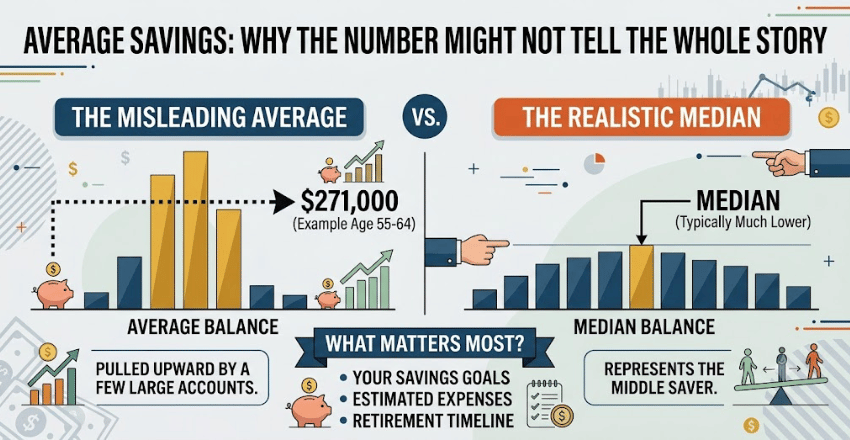
Average balances answer a different question: how much do other people have?
According to figures cited from Vanguard’s participant data, average retirement savings were about $42,000 for people under 35, $103,500 for ages 35 to 44, $189,000 for ages 45 to 54, and $271,000 for ages 55 to 64. The median balances were much lower.
Averages can be pulled upward by a smaller group of high-balance accounts. The median represents the middle participant and often provides a more realistic comparison.
Neither number tells you whether your savings can support your planned retirement. Your own income, expenses, retirement date, and other resources provide a more useful measure.
How Much Should You Contribute?
A practical long-term target is about 15% of gross income, including employer contributions.
You may need a lower starting rate if your budget is tight. The following order can help:
- Contribute enough to receive the complete employer match.
- Build a basic emergency fund.
- Pay down high-interest consumer debt.
- Raise your retirement contribution by one percentage point.
- Repeat the increase after raises or debt repayments.
For 2026, employees can defer up to $24,500 into most 401(k) plans. The limit is a legal maximum, not a required savings target.
A budget binder can help you organize income, bills, savings, and debt payments before choosing a higher contribution rate.
A Better Way to Calculate Your Personal Target

Salary multiples are useful, but a spending-based estimate provides more detail.
Start by estimating your expected annual retirement expenses. Then subtract income you expect from sources outside your investments, such as Social Security, a pension, rental income, or part-time work.
The remaining amount is the annual income your portfolio may need to provide.
For example:
| Retirement estimate | Annual amount |
| Expected spending | $70,000 |
| Social Security and pension income | −$30,000 |
| Income needed from savings | $40,000 |
| Illustrative portfolio at a 4% withdrawal rate | $1,000,000 |
A 4% calculation is a planning estimate, not a guarantee. Fidelity describes a potential sustainable withdrawal range of about 4% to 5% per year, adjusted for inflation, while noting that personal circumstances matter.
Use several scenarios rather than relying on a single forecast. Test higher spending levels, earlier retirement dates, and lower investment returns.
What to Do If You’re Behind
Being below an age benchmark doesn’t mean retirement is out of reach. It means your current plan deserves attention.
Claim the Full Employer Match
Check your plan’s matching formula and vesting rules. Contribute enough to receive every available matching dollar when your budget allows.
Increase Contributions Gradually
A one-percentage-point increase is easier to absorb than a large jump. Schedule another increase when you receive a raise, pay off a loan, or reduce a recurring expense.
Review Your Investment Mix
A large cash allocation may reduce long-term growth, while an overly aggressive portfolio may expose you to losses you can’t tolerate. Choose a diversified allocation that matches your time horizon and comfort with market changes.
Keep Old Accounts Organized
Record each former employer’s plan, balance, fees, investments, and beneficiary details. Consolidation may simplify management, but compare costs and protections before moving money.
Delay Retirement When Practical
Working longer allows more time to contribute, shortens the period your savings must support, and may increase future Social Security income. Fidelity’s models show that retirement timing can materially change the recommended savings multiple.
Find Room in Your Monthly Plan
Reviewing expenses doesn’t require eliminating every enjoyable purchase. Look first for unused subscriptions, high-interest debt, avoidable fees, and spending that doesn’t support your priorities.
Writingley’s monthly savings calculator can help turn a larger goal into a monthly amount.
Factors That May Change Your Target
You may need more than the standard benchmark when you:
- Plan to retire early
- Expect substantial travel or leisure spending
- Have high healthcare expenses
- Support family members
- Expect limited Social Security or pension income
- Still anticipate housing payments during retirement
You may need less when you:
- Plan to work longer
- Expect a reliable pension
- Own your home without a mortgage
- Intend to reduce spending
- Have income-producing assets outside retirement accounts
Don’t lower your goal based on assumptions that haven’t been checked. Build a written estimate and update it each year.
Frequently Asked Questions
How much should I have in my 401 (k) at 40?
Is $100,000 in a workplace retirement account a lot?
Should I include my employer match in the 15% savings target?
Should I max out my account every year?
Does the benchmark include an IRA?
Review Your Number Once a Year
Check your balance, savings rate, investment allocation, fees, beneficiaries, and retirement forecast annually. Also review the plan after a job change, marriage, divorce, a major raise, a home purchase, or a change in your expected retirement date.
Start with the salary benchmark, then create a spending-based estimate. That combination gives you a clearer answer than comparing your balance with a national average. If the gap looks large, increase your contribution in manageable steps and consider consulting a qualified financial professional for advice tailored to your full situation.
If you want to know about How Long Will My Money Last Calculator then visit our Retirement category.