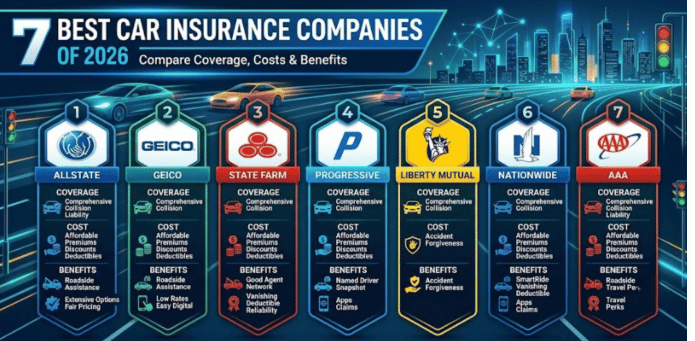
Choosing among car insurance companies requires more than finding the lowest advertised rate. The right insurer must offer suitable coverage, dependable claims service, and competitive pricing for your driver profile. Factors such as discounts, policy flexibility, financial stability, customer reviews, and digital tools can also influence the overall value of an insurance provider.
Current rankings don’t agree on one universal winner. Amica leads NerdWallet’s July 2026 list, while Forbes Advisor and Insurance.com place Travelers first in their evaluations. That difference shows why you should compare insurers based on your own priorities.
| Key question | Practical answer |
| Best starting point for most drivers | Compare Travelers, GEICO, Amica, Progressive, and a strong regional carrier |
| Best for lower average prices | Travelers frequently scores well for price |
| Best for military families | USAA, when eligibility requirements are met |
| Best for coverage add-ons | Progressive |
| Best for claims handling | Erie performs well in several current reviews |
| Quotes to compare | At least three, using identical limits and deductibles |
| Most important checks | Price, complaints, financial strength, coverage, discounts, and local availability |
Direct answer: The strongest insurers for 2026 include Travelers, Amica, GEICO, Progressive, USAA, Erie, and Acuity. No provider is cheapest or strongest for every driver. Start with three to five carriers available in your state, request matching quotes, and compare claims records, coverage limits, deductibles, discounts, and exclusions.
How We Compared Car Insurance Companies
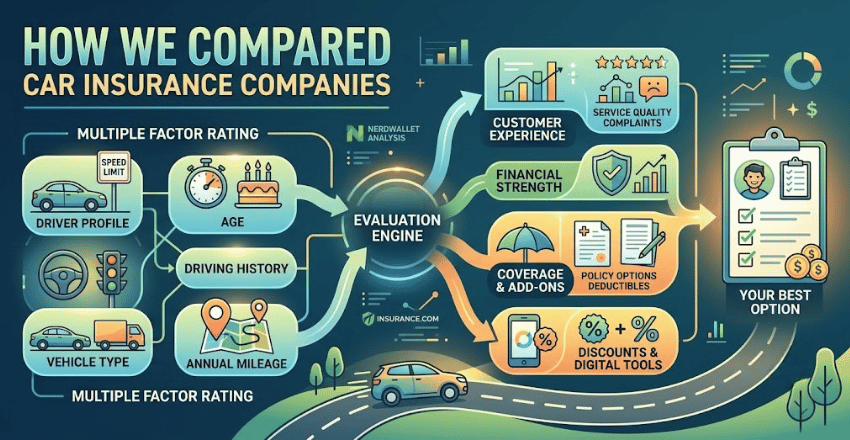
A useful comparison should consider more than a single premium estimate. Rates can change by state, age, driving history, vehicle, annual mileage, chosen limits, and other permitted rating factors. Reviewing coverage features, deductibles, available discounts, and customer service quality provides a clearer picture of the overall policy value.
The current leading reviews assess several of these areas:
- Average rates for different driver profiles
- Consumer complaints reported to regulators
- Claims and customer satisfaction
- Financial strength
- Coverage options and policy add-ons
- Discounts and digital account tools
- Availability by state
NerdWallet says its current analysis considers more than 130 insurers. Its methodology includes financial stability, consumer experience, discounts, and digital usability. Insurance.com combines rates, customer surveys, complaint information, and financial ratings.
Because each publisher uses different weights and data, their winners vary. A better strategy is to use rankings as a shortlist rather than a final purchasing decision. Drivers should also review individual policy details, coverage options, complaint records, and available discounts before choosing an insurer.
Top Insurers for Different Types of Drivers
| Insurer | Strongest use case | Main advantage | Possible limitation |
| Travelers | Price-conscious drivers | Competitive rates across several profiles | Repair-process scores vary by study |
| Amica | Service-focused shoppers | Strong customer experience and coverage | May not be the lowest quote |
| GEICO | Discounts and online service | Broad availability and many savings options | Limited local agent network |
| Progressive | Flexible add-ons | Several optional protections | Rates depend heavily on profile |
| USAA | Eligible military households | Military-focused benefits and discounts | Restricted eligibility |
| Erie | Claims support | Strong repair and claims assessments | Limited state availability |
| Acuity | Low complaint levels | Strong consumer complaint record | Not available nationwide |
1. Travelers: A Strong Choice for Price
Travelers is a practical first quote for drivers focused on cost. Forbes Advisor ranked it highest for price in July 2026, based on the profiles included in its research. Insurance.com also placed it first among national carriers in its 2026 evaluation. Beyond pricing, drivers should compare Travelers’ available coverage options, discounts, customer service experience, and claims handling reputation to determine whether it fits their needs.
Pros
- Competitive average rates in several current studies
- Low complaint levels in major evaluations
- Several optional coverage packages
- New-car replacement and deductible features may be available
Cons
- A low published average doesn’t guarantee your lowest quote
- Some repair-industry evaluations have been less favorable
Travelers makes sense as a starting point, but compare its proposal with at least two other carriers.
2. Amica: A Strong All-Around Option
NerdWallet named Amica its best overall choice for July 2026. The company scored well for financial strength, consumer experience, and available coverage. Amica is also recognized for its customer-focused approach, including strong claims support and a range of policy features that can appeal to drivers seeking dependable protection.
Pros
- Strong service reputation
- Broad policy choices
- High marks in several consumer-focused evaluations
- Suitable for shoppers who value support over the lowest possible premium
Cons
- Your quote may cost more than a budget-focused carrier
- Product availability and terms can vary by location
Amica deserves consideration when claims service and communication matter as much as monthly cost.
3. GEICO: A Good Fit for Discounts and Online Access
GEICO appears near the top of several 2026 rankings. NerdWallet highlights its range of discounts, while Insurance.com places it second among the national carriers it ranked. The insurer may appeal to drivers looking for affordable coverage, easy policy management, and savings opportunities through programs such as multi-policy, safe driving, and vehicle-related discounts.
Pros
- Widely available
- Strong online quoting and account management
- Numerous discount opportunities
- Often competitive for drivers with clean records
Cons
- A smaller local-agent network than some competitors
- Other carriers may price certain violations or credit profiles more favorably
- Gap protection may not be offered in every policy structure
GEICO is worth quoting when you prefer digital service and want to check several discount categories.
4. Progressive: Best for Flexible Policy Extras
Progressive stands out for optional features. Current reviews highlight accident-forgiveness choices and add-ons that may include pet injury protection, trip interruption, or minor-damage coverage.
Pros
- Several accident-forgiveness options
- Useful add-ons for drivers who want customized protection
- Strong digital tools
- May suit drivers with complex insurance histories
Cons
- Optional benefits can raise the premium
- It may not be the cheapest carrier for a clean-record driver
Progressive is a useful comparison for anyone who values policy flexibility more than a bare-bones contract.
5. USAA: Best for Eligible Military Families
USAA is designed for eligible service members, veterans, and qualifying family members. Forbes Advisor highlights military-related savings, including discounts tied to deployment or storing a vehicle on a military base.
Pros
- Products designed around military life
- Competitive pricing for many eligible households
- Military-specific discounts
- Strong customer ratings in several studies
Cons
- Most drivers aren’t eligible
- Complaint or repair results can differ across rating systems
Eligible households should include USAA in their quote comparison, but membership doesn’t remove the need to review limits and exclusions.
6. Erie: A Strong Regional Choice for Claims
Erie receives favorable marks for claims handling in Forbes Advisor’s current review. Insurance.com also rates it strongly among regional carriers and reports competitive average pricing in its study.
Pros
- Strong claims and collision-repair assessments
- Competitive pricing in reviewed markets
- Several useful protections may be included
- Good option for households with younger drivers
Cons
- Available in a limited number of states
- You may need to work through an agent
Don’t overlook a regional insurer. It can outperform a national brand in service, price, or local claims support.
7. Acuity: Best for Low Complaint Levels
Acuity ranks highly in both NerdWallet’s and The Zebra’s 2026 assessments. NerdWallet notes that it receives fewer consumer complaints than expected for its market share.
Pros
- Low complaint levels in recent analyses
- Strong overall consumer scores
- Suitable for drivers who prioritize service consistency
Cons
- Limited geographic reach
- Fewer drivers can request a policy than with a national carrier
Acuity is worth checking when it operates in your state, especially when complaint history is a priority.
How to Choose the Right Insurer

Start by deciding what you need before requesting quotes. Comparing mismatched policies can make one company appear cheaper when it provides less protection. Consider factors such as liability limits, comprehensive and collision coverage, deductibles, roadside assistance, and optional add-ons before evaluating prices.
Use this process:
- Select the same liability limits for every quote.
- Match comprehensive and collision deductibles.
- Add the same optional protections to each proposal.
- Ask which discounts were applied.
- Review exclusions and claim procedures.
- Check whether repair shops or agents are restricted.
- Compare the six-month or annual total, not only the monthly payment.
If you’re unsure how much protection you actually need, read our guide to Car Insurance Michigan Guide before comparing quotes. You can also review our article on Auto and Renters Insurance Bundle to understand how changing your deductible can lower or increase your overall costs.
Don’t Compare Price Alone
A $100 annual saving may not be worthwhile if the cheaper policy removes rental reimbursement, reduces limits, or uses a much higher deductible.
Try a simple “claim-day test.” Ask how each policy would respond if your vehicle were stolen or seriously damaged tomorrow. Check:
- How much you would pay before coverage begins
- Whether you would receive a rental vehicle
- How the insurer values a total loss
- Whether original-equipment parts are covered
- Whether a loan or lease balance could remain
This framework helps you compare the financial result of a claim, not only the price before one occurs.
You should also plan for renewals as an irregular expense. Writingley’s monthly savings calculator can help you divide a six-month or annual premium into a monthly savings target.
Our Verdict
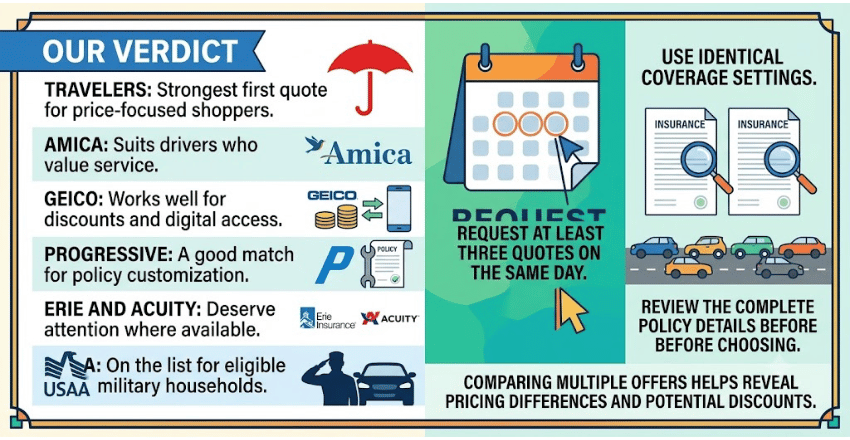
Travelers is the strongest first quote for price-focused shoppers. Amica suits drivers who value service. GEICO works well for discounts and digital access. Progressive is a good match for policy customization. Erie and Acuity deserve attention where available. USAA should be on the list for eligible military households.
Request at least three quotes on the same day. Use identical coverage settings, then review the complete policy details before choosing. Comparing multiple offers helps reveal pricing differences and potential discounts that may not be visible from a single quote.
Conclusion
Choosing the right car insurance companies in 2026 requires balancing price, coverage, customer service, and claims reliability. While Travelers, Amica, GEICO, Progressive, USAA, Erie, and Acuity stand out for different strengths, the best option depends on your location, driving history, vehicle, and personal priorities.
A low premium alone does not always mean better value. Before making a decision, compare matching quotes, review coverage limits, check available discounts, and understand how each insurer handles claims. Taking time to evaluate these factors can help you find a policy that provides dependable protection at a price that fits your budget.
The smartest approach is to treat rankings as a starting point, not the final answer. Request quotes from multiple providers, compare the complete policy details, and choose the insurer that delivers the right combination of affordability, service, and coverage for your specific needs.
If you want to know about Auto Insurance Michigan Guide for 2026 then visit our Insurance category.