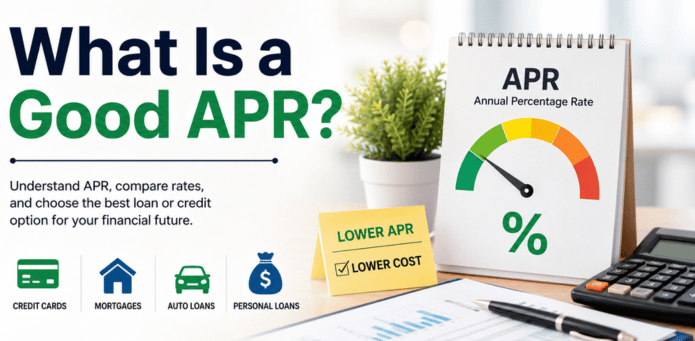
What is a good APR? In most cases, it’s a rate below the current average for the same type of credit and borrower profile. The right benchmark depends on whether you’re comparing a credit card, mortgage, auto loan, or personal loan.
A low rate can reduce your borrowing cost, but the number alone doesn’t tell the full story. You also need to review fees, repayment terms, promotional conditions, and your expected payoff date.
| Key point | What it means |
| What is a good APR? | The yearly cost of borrowing, expressed as a percentage |
| General rule | Lower is usually better when other terms are equal |
| Credit card benchmark | Below the current national average is generally competitive |
| Best advertised offer | A temporary 0% promotion |
| Main personal factor | Your credit history and overall financial profile |
| Best comparison method | Review matching offers for the same amount and term |
What Is a Good APR for Different Types of Credit?
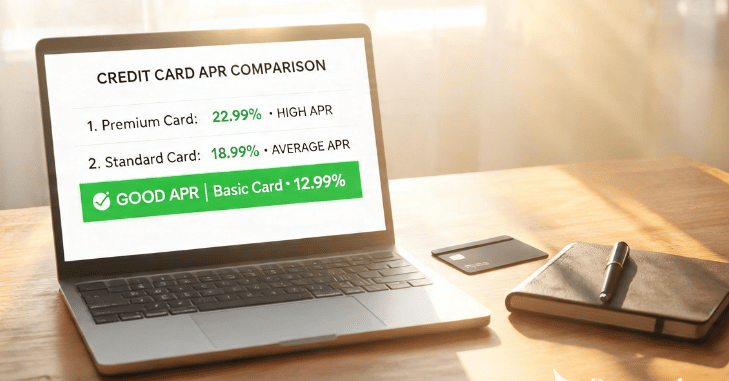
There isn’t one percentage that qualifies as good for every financial product. Credit cards, mortgages, personal loans, and vehicle financing use different pricing methods.
The most useful comparison is between offers for the same product. A 10% personal loan may be competitive, while a 10% mortgage would usually be expensive. Market conditions also change, so fixed numerical rules can become outdated.
Use these standards when reviewing an offer:
| Credit product | A useful benchmark | Important details to check |
| Credit card | Below the current national average | Purchase rate, penalty rate, cash-advance rate and promotional expiration |
| Personal loan | The rates offered to similar borrowers | Origination fee, loan term and total repayment |
| Auto loan | Competitive for your credit tier and vehicle type | New versus used vehicle, term length and dealer markups |
| Mortgage | Competitive against same-day quotes | Points, closing costs, rate lock, and the time you expect to keep the loan |
| Promotional financing | 0% during the offer period | Expiration date, eligible transactions, and deferred-interest rules |
This comparison method is more reliable than choosing an arbitrary number. It accounts for the type of debt and the terms attached to it.
What Is Considered a Good Credit Card Rate in 2026?
- Federal Reserve data released on July 8, 2026, shows that the average rate across credit card accounts was about 21%.
- Accounts that were charged interest had an average above 22%.
- A card priced below those levels can therefore be considered better than average.
- A rate in the low teens would usually be attractive in the current market.
- Single-digit ongoing offers are uncommon and often limited to credit unions or applicants with strong credit.
- A 0% introductory offer is the lowest available rate, but it is temporary.
- Once the promotional period ends, the remaining balance starts using the card’s standard terms.
- Check how long the promotion lasts and whether it applies to purchases, balance transfers, or both.
- The rate may matter less when you pay the full statement balance by the due date.
- Many cards provide a grace period on purchases, allowing you to avoid interest when you don’t carry debt into the next billing cycle.
Writingley’s guide to statement balances and current balances explains which amount normally needs to be paid to retain that grace period.
How the Annual Percentage Rate Works
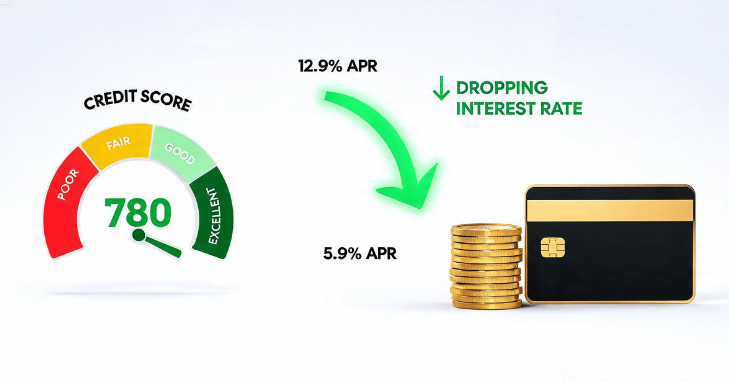
The annual percentage rate expresses borrowing costs on a yearly basis. Its exact calculation and included expenses depend on the product.
For installment loans, the figure can include the interest rate and certain lender charges. This makes it useful when comparing two loans that advertise similar interest rates but charge different upfront fees.
Credit cards work somewhat differently. Their published percentage often functions like an interest rate applied to balances. A card may also list separate rates for:
- Purchases
- Balance transfers
- Cash advances
- Promotional transactions
- Late-payment penalties
Read the pricing disclosure rather than relying on the largest number in an advertisement. A low purchase rate won’t help if you plan to use a cash advance with more expensive terms.
For mortgages, compare both the interest rate and the broader annual cost. Discount points can lower the note rate but increase the amount paid at closing. A cheaper long-term offer may not save money if you sell or refinance before reaching the break-even point.
The Writingley guide to comparing mortgage loan lenders provides a practical method for reviewing rates, points, lender charges, and five-year costs.
Why Your Offered Rate May Be Higher
Lenders price credit according to risk. Applicants who appear more likely to repay on time usually receive more favorable terms.
Several factors may affect your offer:
- Credit score and payment history
- Credit utilization
- Income and employment stability
- Existing monthly debt
- Loan amount and repayment term
- Secured or unsecured borrowing
- Fixed or variable pricing
- New or used collateral
- Current market conditions
Credit card pricing is often connected to the prime rate. When the benchmark changes, variable card rates may change as well. Your agreement normally describes the benchmark and the margin added by the issuer.
A strong credit score doesn’t guarantee the lowest advertised offer. Lenders can also consider income, debt obligations, application information, and their own underwriting rules.
A Simple Way to Compare Borrowing Offers
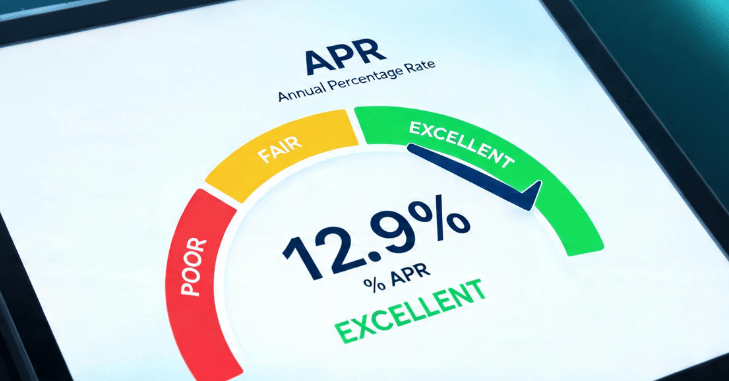
Use the same loan details when requesting quotes. Changing the amount, repayment term, down payment, or product type makes the comparison less useful.
Follow this five-part review:
- Confirm the product and term. Compare a five-year auto loan with other five-year auto loans, not a seven-year alternative.
- Check the total amount borrowed. Make sure optional products or fees haven’t been added to the balance.
- Review upfront charges. Look for origination fees, points, transfer fees, and closing expenses.
- Calculate total repayment. A smaller monthly payment may cost more when it stretches the debt across additional years.
- Read special conditions. Check promotional deadlines, variable-rate rules, penalties, and eligibility requirements.
For example, suppose Loan A has a 9% interest rate and a large origination fee. Loan B carries a 9.5% rate without that fee. The second offer could cost less, especially when the repayment period is short.
This is why borrowers should compare the broader annual cost rather than the advertised interest rate alone. The Federal Reserve defines consumer lending rates under Regulation Z, while loan disclosures are designed to help consumers compare borrowing costs.
When a Higher Rate May Still Be Acceptable
The lowest percentage isn’t automatically the best choice. A slightly higher rate may be reasonable when an offer provides:
- No origination fee
- A shorter repayment period
- Flexible payment dates
- No prepayment penalty
- Better customer support
- A fixed rate instead of a variable one
- More suitable approval requirements
You should still calculate the full cost. Convenience doesn’t justify paying hundreds or thousands of dollars more without a clear benefit. Credit card rewards also shouldn’t distract you from the expensive interest. Cash back and travel points rarely offset the cost of carrying a large balance for months.
How to Improve the Rate You Receive
Start by checking your credit reports for inaccurate information. Dispute errors before submitting an important application.
You can also strengthen your application by:
- Paying every bill by its due date
- Reducing revolving balances
- Avoiding several new accounts before applying
- Lowering your debt-to-income ratio
- Choosing a realistic borrowing amount
- Comparing several banks, credit unions, and online lenders
- Applying with a qualified co-borrower when appropriate
Tracking your spending can help you find money for debt repayment. Writingley’s seven-step expense tracking guide offers a simple system for recording bills, purchases, and savings.
Ask whether a lender offers relationship discounts, automatic-payment reductions, or secured alternatives. Don’t open an account or pledge collateral until you understand the risks and conditions.
Questions to Ask Before Accepting an Offer
Before signing, ask the lender:
- Is the rate fixed or variable?
- Which fees are included?
- Can the rate change after approval?
- Is there a promotional period?
- What happens when that period ends?
- Is there a prepayment penalty?
- What is the total repayment amount?
- Does the offer require automatic payments?
- Could a shorter term reduce the cost?
- When will I receive the final disclosure?
Get the answers in writing. Save copies of your application, disclosures, and payment schedule.
Conclusion
Understanding what a good APR is essential before accepting any credit card or loan offer. A competitive APR is generally one that is lower than the current average for the same type of borrowing and matches your credit profile. However, the interest rate is only one part of the total borrowing cost.
You should also compare fees, repayment terms, promotional offers, and the overall amount you will repay over time. By carefully evaluating every aspect of an offer instead of focusing on the APR alone, you can choose financing that supports your financial goals while keeping borrowing costs as low as possible.
Frequently Asked Questions
What is a good APR for someone with good credit?
Is 24% high for a credit card?
Does 0% mean borrowing is free?
Is a lower rate always better?
Can I negotiate my rate?
Choose the Offer by Total Cost
A good borrowing rate is one that compares favorably with current offers for your credit profile and chosen product. Start with market averages, but don’t stop there.
Compare fees, repayment length, monthly payments, promotional rules, and total cost. For more guides on borrowing and credit management, explore Writingley’s credit resources.