
The Rule of 72 is a quick formula for estimating how many years an investment may take to double. Divide 72 by the expected annual return. An investment earning 8% per year, for example, would double in about nine years. This shortcut helps investors understand the effect of compound growth without using complex calculations.
You can also reverse the formula to estimate the annual return required to double your money in a given number of years. The result is only an estimate, not a guaranteed investment outcome. Actual returns may vary due to market performance, inflation, fees, and tax effects. For the full picture, read Junk Fees.
| Key detail | Explanation |
| Main formula | Years to double = 72 ÷ annual return |
| Reverse formula | Required return = 72 ÷ years |
| Best suited for | Fixed, compounded annual growth |
| Most accurate range | Roughly 6% to 10% annual returns |
| Useful for | Investments, inflation, fees, and financial planning |
| Main limitation | It assumes a constant rate and ignores taxes and market changes |
Direct answer: Divide 72 by an investment’s expected annual percentage return. The answer estimates how many years it may take for the investment to double through compounding. At an 8% return, the calculation is 72 ÷ 8, producing an estimated doubling period of nine years.
How Does the Rule of 72 Work?
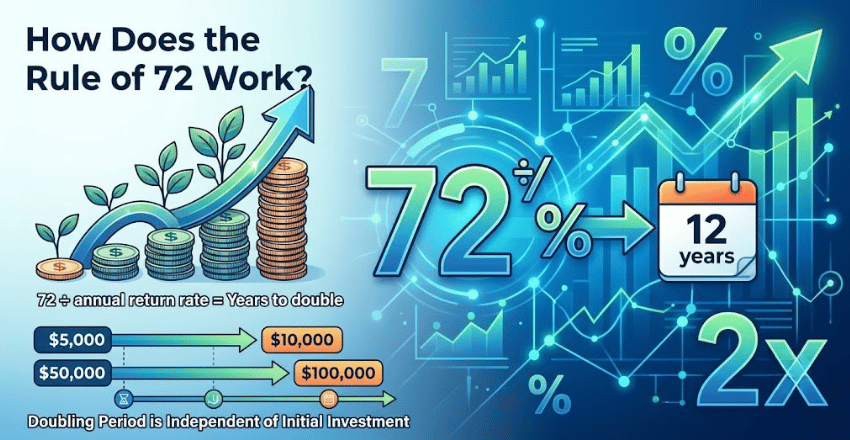
The calculation uses two numbers: 72 and an annual percentage rate.
The standard formula is:
Years to double = 72 ÷ annual return rate
Suppose you invest $5,000 and expect an average annual return of 6%. Divide 72 by 6:
72 ÷ 6 = 12 years
The estimate suggests that your $5,000 could grow to about $10,000 in 12 years, assuming the return remains steady and all earnings stay invested.
The starting balance doesn’t change the estimated doubling period. A $500 balance and a $50,000 balance earning the same compounded rate would take about the same time to double.
That happens because the formula measures the growth rate rather than the dollar amount.
Doubling-Time Examples at Different Returns
The following table shows how a higher annual return shortens the estimated doubling period.
| Annual return | Calculation | Estimated time to double |
| 3% | 72 ÷ 3 | 24 years |
| 4% | 72 ÷ 4 | 18 years |
| 5% | 72 ÷ 5 | 14.4 years |
| 6% | 72 ÷ 6 | 12 years |
| 8% | 72 ÷ 8 | 9 years |
| 9% | 72 ÷ 9 | 8 years |
| 10% | 72 ÷ 10 | 7.2 years |
| 12% | 72 ÷ 12 | 6 years |
Small differences in long-term returns can create major changes over time. A 6% return doubles money in about 12 years, while an 8% return does so in about 9 years, illustrating the impact of compounding. Over longer periods, these small gaps can lead to significantly different investment outcomes.
Still, you shouldn’t select an investment based only on the fastest projected result. Higher potential returns often involve greater uncertainty and a higher chance of losses. A balanced investment approach considers risk, time horizon, and financial goals before making decisions.
How to Calculate the Return Needed to Double Your Money
You can reverse the equation when you already have a target period.
Use this formula:
Required annual return = 72 ÷ desired doubling period
Suppose you want an investment to double in ten years:
72 ÷ 10 = 7.2%
You would need an average compounded annual return of about 7.2%, before accounting for taxes, charges, or withdrawals.
Here are several examples:
| Desired doubling period | Approximate return needed |
| 5 years | 14.4% |
| 6 years | 12% |
| 8 years | 9% |
| 10 years | 7.2% |
| 12 years | 6% |
| 15 years | 4.8% |
| 20 years | 3.6% |
This calculation can help you test whether a financial target appears realistic. It doesn’t tell you which investment will earn the required return or whether that return is achievable. Investors should also consider market conditions, risk levels, and investment timeframes before making decisions.
Use Writingley’s monthly savings calculator when your plan includes regular deposits. The doubling shortcut assumes a single balance growing without further contributions. Regular savings can accelerate growth by adding new money over time and increasing the effect of compounding.
Why the Number 72 Is Used?

The exact compound-growth calculation involves logarithms, which aren’t convenient for mental math. The number 72 creates a close estimate at common annual return rates. This makes the Rule of 72 a simple tool for quick financial comparisons and planning.
It’s also easy to divide because it has many factors, including 2, 3, 4, 6, 8, 9, and 12. This makes calculations simple without a financial calculator. The Rule of 72 is especially useful for quickly comparing different investment return scenarios.
The shortcut is especially close around an 8% annual rate. At 8%, it estimates nine years. The exact compound-interest result is about 9.01 years. Accuracy generally falls as rates move far below or above the middle single-digit range.
For precise projections, use the compound-interest formula:
Doubling time = ln(2) ÷ ln(1 + r)
In this equation, “r” is the annual return written as a decimal. A spreadsheet or financial calculator can complete the calculation.
Using the Shortcut to Understand Inflation
The same calculation can illustrate how inflation reduces purchasing power. As prices rise, money loses value over time, causing savings to buy fewer goods and services in the future. This helps show why investors often consider returns that can outpace inflation when planning long-term goals.
Divide 72 by the annual inflation rate to estimate how long it may take prices to double. That also indicates when the purchasing power of an unchanged amount of money could fall by roughly half. This provides a quick way to understand the long-term impact of rising costs on savings and spending power.
72 ÷ 3 = 24 years
If inflation stayed at 3%, an item costing $100 today could cost about $200 after 24 years. Actual inflation changes from year to year, so this remains a planning illustration. For a clearer view of the money available for saving and investing, begin by learning how to track expenses. Reliable cash-flow records make long-term assumptions easier to evaluate.
How Fees Can Slow Compounding
Investment fees may look small when expressed as annual percentages. Their long-term effect can be significant because they reduce the return that remains available to compound. Over many years, even a small fee difference can noticeably impact the final investment balance.
Imagine two investments before taxes:
| Investment | Gross annual return | Annual fee | Approximate net return | Estimated doubling time |
| Fund A | 8% | 0.25% | 7.75% | 9.3 years |
| Fund B | 8% | 1.50% | 6.50% | 11.1 years |
This comparison is simplified. Real results depend on how fees are charged, market performance, taxes, and the timing of cash flows. The useful lesson is to compare net returns, not only the headline performance figure. Costs reduce the amount left in your account and may lengthen the time required to reach a goal.
When the Formula Is Most Useful
The shortcut works well for quick estimates when:
- Growth compounds over time.
- You have a reasonable assumption for the annual rate.
- Earnings remain invested.
- You don’t make withdrawals.
- You need a fast comparison rather than an exact forecast.
You might use it to compare two fixed-rate accounts, review a long-term return assumption, or explain the effect of inflation. It can also help you spot unrealistic claims. An offer promising to double your money in three years implies an annual return near 24%, since 72 ÷ 3 equals 24.
Limitations You Should Know
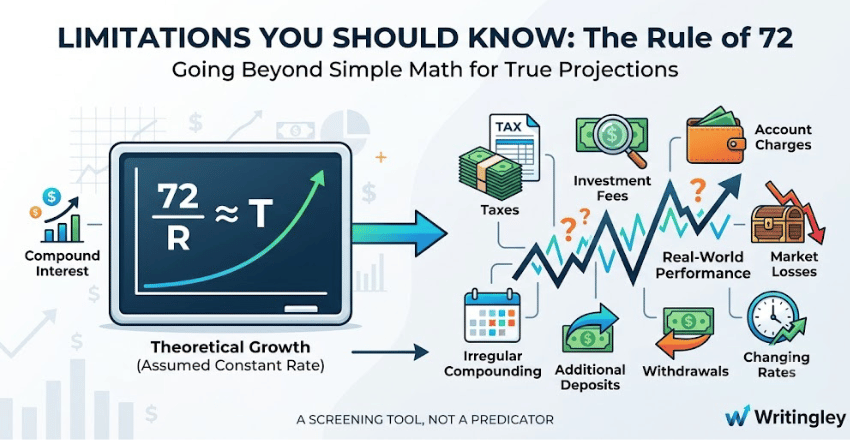
The Rule of 72 doesn’t predict actual market performance. It assumes a stable annual rate, while stocks, funds, and other market investments may rise or fall each year. It is mainly a quick estimation tool for understanding potential growth over time.
It also leaves out:
- Taxes on interest, dividends, or gains
- Investment management fees
- Account charges
- Additional deposits
- Withdrawals
- Changing interest rates
- Market losses
- Irregular compounding periods
The formula applies to compound growth rather than simple interest. With simple interest, earnings are calculated only on the original principal, so the balance follows a different growth pattern. Treat the result as a screening tool. Use a compound-interest calculator or detailed financial projection before making a major decision.
A Practical Three-Step Check
Before relying on a doubling estimate, ask three questions:
- Is the return compounded? The formula isn’t designed for simple interest.
- Is the assumed rate realistic? Use a rate that fits the asset and its risk.
- What reduces the return? Account for fees, taxes, inflation, and withdrawals.
This check separates a useful estimate from a misleading projection. It also prevents you from treating a mathematical shortcut as an investment promise.
Put the Estimate Into Context
Calculate your estimated doubling period, then test the assumption against fees, taxes, inflation, and possible market changes. Use the result to compare scenarios rather than predict a guaranteed future balance. A quick calculation can clarify your goal. A detailed savings or investment plan should determine how you pursue it.
Conclusion
The Rule of 72 is a simple yet powerful tool for estimating how long it may take an investment to double or how much return is needed to reach a financial goal. While it cannot predict exact market results, it helps investors quickly understand the impact of compounding, inflation, fees, and long-term growth.
Use this formula as a starting point for financial planning, not as a guarantee of future performance. Combining the Rule of 72 with careful research, realistic return expectations, and a clear understanding of risks can help you make smarter decisions about saving and investing.
If you want to know about How to Fill Out a Money Order Correctly then visit our Finance category.