
Learning how to save 10k in a year starts with turning one large goal into smaller deposits. You need to set aside about $833 per Month, $385 per biweekly paycheck, $192 per week, or $27.40 per day. Then, combine automatic transfers, selected spending cuts, and extra income to meet your target.
Saving that amount may require meaningful changes, but it doesn’t mean removing every enjoyable expense. A realistic plan protects essential costs, leaves room for some flexible spending, and gives every saved dollar a clear destination.
| Savings-plan detail | Target |
| Annual goal | $10,000 |
| Monthly contribution | $833.33 |
| Biweekly contribution | $384.62 |
| Weekly contribution | $192.31 |
| Daily average | $27.40 |
| Recommended review schedule | Once per Month |
| Best place for short-term savings | A separate, accessible savings account |
The figures above are calculated by dividing $10,000 by 12 months, 26 biweekly pay periods, 52 weeks, or 365 days.
What You’ll Need Before You Start
Gather the following information before building your plan:
- Your monthly take-home income
- Bank and credit card statements from the past two or three months
- A list of fixed bills and debt payments
- Your average spending on food, transport, shopping, and entertainment
- A separate account for the goal
- A simple spreadsheet, notebook, or budgeting app
Accurate numbers matter more than an ideal-looking budget. A government consumer budgeting guide recommends listing income, bills, and other expenses before deciding how much money is available.
For more guides on managing income and expenses, visit Writingley’s budgeting resources.
How to Save 10k in a Year in 7 Steps
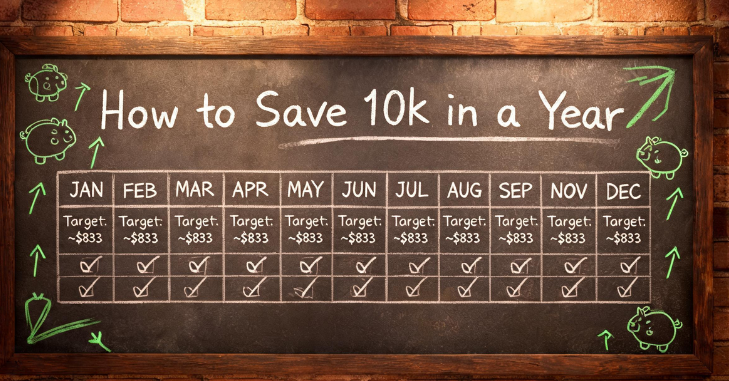
Learning how to save 10k in a year starts with small, consistent financial habits.
With discipline and smart planning, reaching your savings goal becomes much more achievable.
1. Choose a Deposit Schedule That Matches Your Pay
Start by selecting the contribution schedule that fits your income.
A monthly schedule works well for salaried workers paid once or twice a month. Weekly contributions may feel easier for hourly workers or anyone with changing income.
Use one of these targets:
- Save $833.33 each Month.
- Save $384.62 from every biweekly paycheck.
- Save $192.31 each week.
- Save an average of $27.40 each day.
Several current savings guides use the same monthly and weekly breakdown because smaller targets are easier to track than one annual number.
Don’t round the monthly target down to $833 for all 12 months. That would leave you $4 short. Save $834 in four months and $833 in the remaining eight, or schedule an exact transfer of $833.34.
2. Measure Your Current Savings Gap
Your savings gap is the difference between your required monthly deposit and the amount you already save each Month.
Suppose you currently save $300 per Month:
- Required monthly target: $833
- Current monthly savings: $300
- Monthly gap: $533
You don’t need to find the full $833 through spending cuts. In this example, you only need a plan for the remaining $533.
Review at least two months of transactions. Sort each expense into fixed needs, variable needs, flexible wants, debt payments, and existing savings. This gives you a clearer view than guessing from memory.
3. Create a Three-Part Funding Plan

A common mistake is expecting small sacrifices, such as skipping coffee, to fund the entire goal. A stronger method uses three sources:
| Source | Monthly target | Annual contribution |
| Existing savings capacity | $300 | $3,600 |
| Reduced spending | $250 | $3,000 |
| Added income | $284 | $3,408 |
| Total | $834 | $10,008 |
This example is useful because it spreads the pressure. You aren’t depending on one drastic cut or an unreliable side job.
Adjust the three amounts to suit your situation. Someone with high income may fund most of the target through existing cash flow. A tighter household budget may need a larger income component.
Writingley’s personal finance section can support broader research on saving and money management.
4. Cut a Few Large or Repeated Expenses
Focus on changes that produce measurable savings. Cutting ten tiny purchases can create more work than changing two recurring costs.
Review these categories first:
- Insurance premiums
- Mobile and internet plans
- Unused memberships
- Streaming subscriptions
- Restaurant and delivery spending
- Grocery waste
- Transport costs
- Impulse shopping
- Bank or credit card fees
For example, reducing takeout by $120, canceling $40 in subscriptions, and lowering insurance or phone costs by $90 would free $250 per Month. That equals $3,000 over one year.
Don’t count a reduction until the money reaches your savings account. Spending $50 less on groceries won’t help if the same $50 ends up in another category.
5. Automate the Transfer After Payday

Set an automatic transfer for the day you receive your income or the following morning. This treats the deposit like a required bill rather than whatever is left at month-end.
Automation is a recurring recommendation across current financial guidance. Experian advises setting transfers from checking so contributions happen without repeated manual action. Bankrate also recommends automatic deposits at a fixed amount or a percentage of your paycheck.
Keep the money in a separate account. Separation reduces the chance that you’ll treat the balance as everyday spending money.
For a one-year goal, prioritize accessibility and stability. Check account terms, withdrawal restrictions, minimum balances, fees, and deposit protection before opening an account.
6. Add Income With a Specific Monthly Target
If your budget can’t produce the full amount, assign a precise income goal instead of saying you’ll “make more money.”
Possible sources include:
- Freelance work related to your existing skills
- Overtime or additional shifts
- Tutoring or lessons
- Pet sitting or household services
- Selling unused electronics, furniture, or clothing
- Seasonal work
- A negotiated raise
- Bonuses, refunds, or commissions
Experian includes higher earnings and selling unused items among its main strategies for reaching the annual target.
Calculate earnings after expenses and taxes. If a side activity brings in $400 but costs $80 to operate, only $320 should count toward the goal.
Send extra income to savings as soon as you receive it. Leaving it in your main account makes it easier to spend.
7. Review Progress and Correct Small Shortfalls
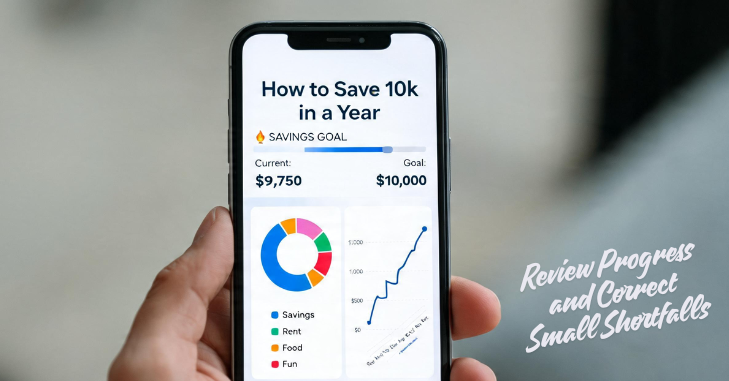
Check the balance at the end of each Month. Compare your actual total with these milestones:
| End of Month | Target balance |
| 1 | $833 |
| 3 | $2,500 |
| 6 | $5,000 |
| 9 | $7,500 |
| 12 | $10,000 |
A missed month doesn’t end the plan. Divide the shortfall across the remaining months.
Suppose your balance is $4,400 after six months. You are $600 behind the halfway target. Divide that amount by the remaining 6 months, which adds $100 to each remaining monthly contribution.
Make corrections early. A $300 shortfall is manageable in March but harder to fix in December. Writingley’s credit education hub covers credit reports and responsible borrowing.
What to Do When $833 per Month Isn’t Realistic
First, decide whether the deadline or the amount is more important.
At $500 per Month, reaching $10,000 takes 20 months before interest. Bankrate and Experian provide the same general timeframe for that contribution level.
You have four practical options:
- Extend the deadline.
- Reduce the target.
- Increase income.
- Use a planned windfall as part of the total.
Don’t skip rent, utilities, insurance, minimum debt payments, medication, or other essential costs to maintain an arbitrary deadline.
If high-interest debt is growing faster than your cash balance, compare the cost of that debt with your reason for saving. A small emergency reserve may still be useful, but aggressive saving alongside expensive revolving debt can work against your wider financial position.
Common Mistakes That Can Derail the Plan

Counting Expected Money Too Early
Don’t include a future bonus, refund, or sale until you receive it. Treat uncertain income as an extra contribution, not part of your base plan.
Setting an Extreme Budget
A plan with no room for irregular expenses will fail when a car repair, an annual bill, or a family event arises. Add a small buffer category to your monthly budget.
Saving Only at the End of the Month
Waiting to see what remains gives other spending priority. Transfer your planned contribution near payday instead.
Ignoring Progress for Several Months
Monthly reviews help you fix a small gap before it becomes a major shortfall. Track deposits, not only your account balance.
Investing Money Needed Within One Year
Market investments can lose value over short periods. For a firm one-year deadline, consider whether you can accept that risk before investing the funds.
Frequently Asked Questions
What is the easiest way to learn how to save 10k in a year?
How much must I save every paycheck?
What is the $27.40 savings rule?
Can I reach the goal on a low income?
Where should I keep the money?
Start With Your First Transfer
Pick your contribution schedule today. Open or designate a separate account, schedule the first automatic transfer, and enter your first monthly milestone on a calendar.
The annual figure may look demanding, but your next action is much smaller. Your job is to fund the next weekly or monthly target, review the result, and adjust before a shortfall grows.