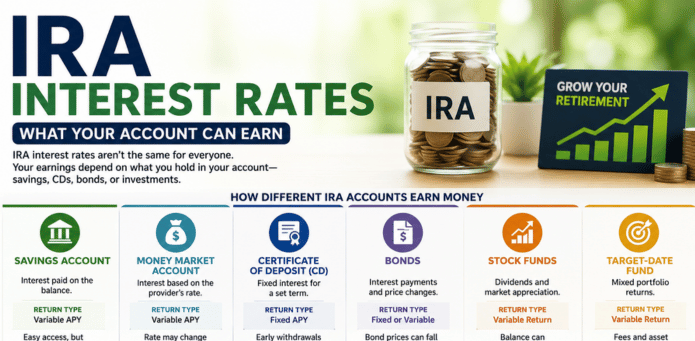
IRA interest rates aren’t set by the government or attached to every retirement account. Your earnings depend on what you hold inside the account. An IRA savings account may pay a variable rate, while an IRA CD offers a fixed APY. A brokerage account can hold investments whose returns rise or fall.
| Key point | What it means |
| Standard account rate | There is no universal rate for all IRAs |
| Bank IRA | May hold savings accounts, money market products, or CDs |
| Brokerage IRA | May hold stocks, bonds, mutual funds, and ETFs |
| Fixed return | Usually available through an IRA CD |
| Variable return | Common with savings accounts and market investments |
| Main comparison figure | APY for deposit products; total return for investments |
| 2026 contribution limit | $7,500, or $8,600 for people age 50 or older |
| Main risk | Choosing a low return that fails to keep pace with inflation |
Direct answer: An IRA doesn’t usually have one standard interest rate. Bank-based accounts earn the stated APY on savings or certificates of deposit. Investment-based accounts earn returns from stocks, bonds, mutual funds, or exchange-traded funds. Your provider, asset choices, fees, term length, and market conditions determine how quickly the balance grows.
What Are IRA Interest Rates?
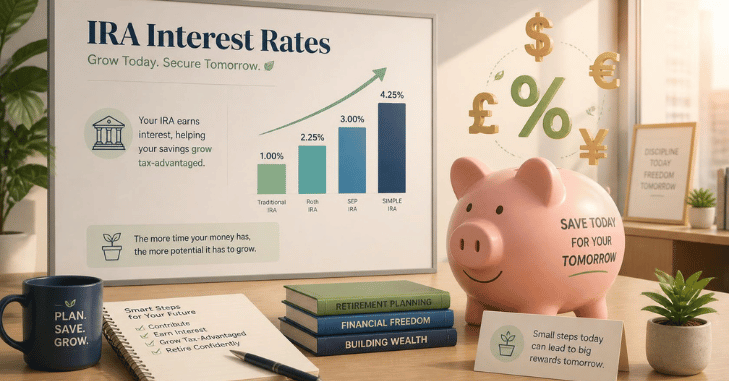
“The phrase These products may include savings accounts, money market accounts, and certificates of deposit.
The retirement account itself is a tax structure, not a single investment. The IRS says you can establish one through a bank, insurance company, mutual fund, or stockbroker. Each provider may offer different assets and potential returns.
This distinction matters because two people can open the same type of retirement account and earn different results. One person may choose a one-year CD with a fixed yield. Another may buy stock funds whose value changes each day.
A Roth account also doesn’t have a built-in fixed rate. Its return depends on the assets selected within it. Bank versions tend to offer deposit products, while brokerage versions may offer a wider range of investment options.
How Do Different IRA Accounts Earn Money?
The way your balance grows depends on where you open the account and what you buy.
| Holding | How it earns money | Return type | Main trade-off |
| Savings account | Interest paid on the balance | Variable APY | Easy access but often a lower yield |
| Money market account | Interest based on the provider’s rate | Variable APY | The rate may change after opening |
| Certificate of deposit | Fixed interest for a set term | Fixed APY | Early withdrawals may trigger penalties |
| Bonds | Interest payments and price changes | Fixed or variable | Bond prices can fall when market rates rise |
| Stock funds | Dividends and market appreciation | Variable return | Balance can lose value |
| Target-date fund | Mixed portfolio returns | Variable return | Fees and asset allocation affect results |
IRA Savings Accounts

A retirement savings account works much like a regular bank savings account. Your money earns interest, and eligible deposits at an insured bank receive FDIC protection within applicable coverage limits. The rate is usually variable.
Your bank can raise or lower it as economic conditions and its funding needs change. This option may suit someone who values balance stability and easy access within the account. Yet the yield may not provide sufficient long-term growth to meet a retirement goal.
IRA certificates of deposit
An IRA CD pays a fixed APY for a stated period, such as 6 months, 1 year, or 5 years. Longer terms don’t always pay more, so you should compare every available term.
The rate normally stays fixed until maturity. That makes your return predictable, but access is restricted. A bank may charge a CD penalty when you withdraw before maturity. A retirement-plan withdrawal could also have separate tax consequences.
Current offers vary by institution and can change without notice. For example, Synchrony states that its CD yields are subject to change and that early withdrawals may produce a penalty. It also notes that renewal rates can differ from the original yield.
Brokerage investments
A brokerage retirement account may hold stock funds, bond funds, ETFs, individual securities, and other permitted investments. These assets don’t pay a guaranteed account rate.
Your result is measured as an investment return. It may include:
- Changes in the asset’s market price
- Dividends from stocks or funds
- Interest from bonds
- Reinvested distributions
- Fees and trading costs
Market-based investments can provide more growth potential than deposit products. They can also lose value, especially over short periods.
What Determines the Rate You Receive?
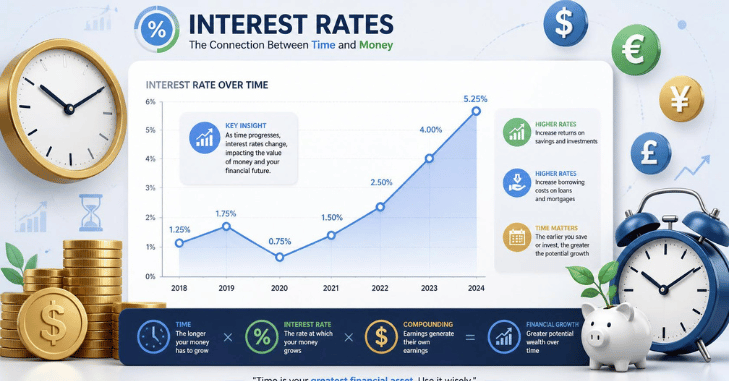
Several factors affect the yield or return available within your account.
The product you select
A savings account, a CD, a bond, and a stock fund work differently. Compare like with like. A guaranteed CD yield shouldn’t be treated as equivalent to an estimated stock-market return.
The term length
CD providers often publish different APYs for each maturity. A one-year certificate might pay more than a three-year certificate when financial markets expect rates to decline.
A longer term can protect an attractive yield. It can also leave your money locked in when newer products begin paying more.
Federal Reserve policy
Bank deposit rates often respond to changes in short-term market rates. When prevailing rates rise, banks may increase yields on savings and CDs. When rates fall, new certificates and variable-rate products may pay less.
Your existing fixed-rate CD normally keeps its stated yield until maturity. Its renewal rate will reflect the provider’s available offer at that time.
Account fees
Fees reduce the return that stays in your account. Review maintenance fees, fund expense ratios, advisory charges, transaction costs, and transfer fees.
A small annual percentage can become meaningful over several decades. Compare returns after costs rather than focusing on the advertised yield alone.
Your provider
Banks, credit unions, brokerages, and investment advisers offer different products. One institution may focus on insured CDs. Another may provide thousands of mutual funds and ETFs.
Check minimum deposits, withdrawal restrictions, investment choices, service options, and insurance coverage before comparing the headline rate.
Fixed Interest Versus Investment Returns
A higher advertised number isn’t automatically the better choice. The right option depends on your timeline and ability to accept losses.
Fixed-interest products may suit you when
- You expect to use the money within a few years.
- Protecting the balance is a high priority.
- You want predictable earnings.
- You’re building a conservative part of your portfolio
Market Investments May Suit You When

- Retirement is many years away.
- You can tolerate short-term declines.
- Long-term growth is the main goal.
- You want broader diversification.
You can also combine both approaches. For example, a retiree might keep near-term withdrawals in CDs while holding longer-term assets in diversified funds.
Before choosing an assumed return, try Writingley’s monthly savings calculator. It shows how your contribution, timeline, and expected growth rate work together.
A Simple Return Comparison
Consider a hypothetical $7,500 contribution left untouched for ten years.
| Assumed annual return | Approximate value after 10 years |
| 2% | $9,143 |
| 4% | $11,102 |
| 6% | $13,431 |
| 8% | $16,192 |
These figures assume annual compounding, no added contributions, and no fees. They aren’t forecasts or guaranteed outcomes. The table shows why small differences matter. An 8% assumption produces about $7,049 more than a 2% assumption after ten years. Yet the higher expected return usually comes with more uncertainty and risk.
Regular contributions can have an even greater effect. The IRS raised the 2026 annual limit to $7,500. People age 50 or older can add a $1,100 catch-up contribution, for a total of $8,600.
Use those limits as maximums, not required targets. Your contribution can’t exceed the applicable legal limit or your eligible taxable compensation.
How to Compare Accounts?
Follow a consistent process instead of choosing the provider with the largest number on its homepage.
- Identify the product. Determine whether the quoted figure is a savings APY, CD APY, bond yield, or historical investment return.
- Check whether it’s fixed. Find out whether the provider can change the rate after it has been opened.
- Review the term. Note maturity dates, renewal terms, and early withdrawal penalties.
- Confirm the minimum. Some products require a minimum opening deposit or balance.
- Calculate fees. Subtract account and investment costs from the expected return.
- Review protection. Confirm FDIC or NCUA coverage for eligible deposits and understand its limits.
- Match your timeline. Avoid locking near-term spending money into a long certificate.
- Read the tax rules. Traditional and Roth accounts receive different tax treatment.
You can also review the site’s investing resources for more guidance on risk, markets, and investment choices.
Common Mistakes to Avoid
Assuming the IRA pays a standard rate
It doesn’t. The assets inside the account create the return. Always identify the underlying product.
Leaving cash uninvested by accident
Cash transferred to a brokerage may remain in a settlement account until you select an investment. Check your account after contributing.
Comparing APY with historical stock returns
APY is a defined annual yield for a deposit product. A historical market return reflects past performance and doesn’t guarantee future results.
Chasing a temporary promotional offer
A high introductory yield may expire. Review the ongoing rate, maturity rules, and renewal process.
Ignoring inflation
Even with a stable balance, purchasing power can still decline. Compare your expected after-fee return with your long-term needs, not only with a zero-return account.
Conclusion
IRA interest rates depend on the investments or deposit products you choose—not the IRA itself. Whether you keep your retirement savings in a high-yield savings account, an IRA CD, bonds, or a diversified investment portfolio, each option offers a different balance of growth potential, stability, and risk.
Understanding how these choices affect your long-term returns is essential to building a retirement strategy that aligns with your financial goals. Rather than focusing only on the highest advertised rate, compare account fees, investment options, inflation, and your retirement timeline.
Consistently contributing up to the annual IRS limit, selecting investments that fit your risk tolerance, and reviewing your portfolio regularly can have a far greater impact on your retirement savings than chasing short-term promotional yields. A well-planned IRA strategy helps your money grow more effectively and supports greater financial security throughout retirement.
Apart from that, if you want to know about the article 401(k) Savings by Age, then visit our Retirement category.