
A CD calculator estimates how much your certificate of deposit could be worth at maturity. Enter your starting deposit, annual percentage yield, and term length. The result shows your projected interest earnings and final balance, helping you compare accounts before locking away your savings.
Use the tool with multiple rates and terms rather than relying on a single estimate. Small differences in APY can produce noticeably different returns on larger deposits or longer terms.
| Calculator detail | What to enter or review |
| Initial deposit | The amount placed into the account |
| APY | The advertised annual percentage yield |
| Term | How long the money remains deposited |
| Interest earned | Projected return before taxes or penalties |
| Maturity balance | Initial deposit plus projected interest |
| Best use | Comparing fixed-rate deposit options |
Direct answer: Enter the amount you plan to deposit, the advertised APY, and the certificate’s term. The calculator applies compound growth to estimate your maturity balance. Subtract your original deposit from that balance to see your projected interest earnings.
How to Use the CD Calculator

You need three figures to produce an estimate: your deposit, the APY, and the term.
- Enter your initial deposit. Use only the money you can leave untouched until maturity.
- Add the advertised APY. Check that you’re entering APY rather than a simple interest rate.
- Select the term. Enter the number of months or years stated by the financial institution.
- Review the projected interest. This is the amount earned above your original deposit.
- Check the maturity value. This figure combines your principal and projected earnings.
- Test another scenario by changing the APY or term to compare competing offers.
Most traditional certificates accept one opening deposit. You usually can’t add money after the account has been funded. Confirm this rule with the institution before opening an account.
The calculator assumes the money remains deposited for the full term. An early withdrawal can reduce the return because the institution may charge a penalty.
What Determines Your Certificate Earnings?
Three main variables affect the result.
Initial deposit
A larger deposit earns more interest when the APY and term stay the same. For example, an account containing $20,000 will earn twice as much as a $10,000 account under identical terms.
Don’t deposit money you may need for routine bills or emergencies. You can use Writingley’s monthly savings calculator to separate a future savings goal from the amount available for a fixed-term account.
Annual percentage yield
APY represents the yearly return after accounting for compounding. It offers a clearer comparison than a basic interest rate because it reflects how often earnings are added to the balance.
When comparing offers, check that both institutions quote APY for the same term. A high advertised yield may apply only to a specific balance, account type, or promotional period.
Term length
The term is the period between opening and maturity. Common options include several months, one year, 18 months, and multiple years.
A longer term gives the deposit more time to earn interest. It doesn’t guarantee a higher APY, though. Rate structures can favor shorter terms during certain economic conditions. Compare the actual offers available rather than assuming the longest option pays the most.
Example Certificate of Deposit Calculations
The table below uses a $10,000 deposit and a hypothetical 4.25% APY. It assumes the advertised APY remains in effect and that the money stays in the account until maturity.
| Term | Starting deposit | APY | Estimated balance | Estimated interest |
| 12 months | $10,000 | 4.25% | $10,425.00 | $425.00 |
| 18 months | $10,000 | 4.25% | $10,644.23 | $644.23 |
| 3 years | $10,000 | 4.25% | $11,329.96 | $1,329.96 |
These figures show why both the rate and time matter. Extending the term from one year to three years adds more than two extra years of interest. It also keeps your money unavailable for longer.
Here is another example. A $5,000 deposit earning 4% APY for five years would grow to about $6,083.26. That represents approximately $1,083.26 in interest, assuming no withdrawals or penalties.
This comparison framework is useful when reviewing offers:
- Calculate the return from the highest available APY.
- Calculate a shorter term with greater flexibility.
- Estimate the result after any expected tax.
- Compare the extra earnings with the longer lockup period.
- Read the early-withdrawal terms before choosing.
How Certificate Interest Is Calculated
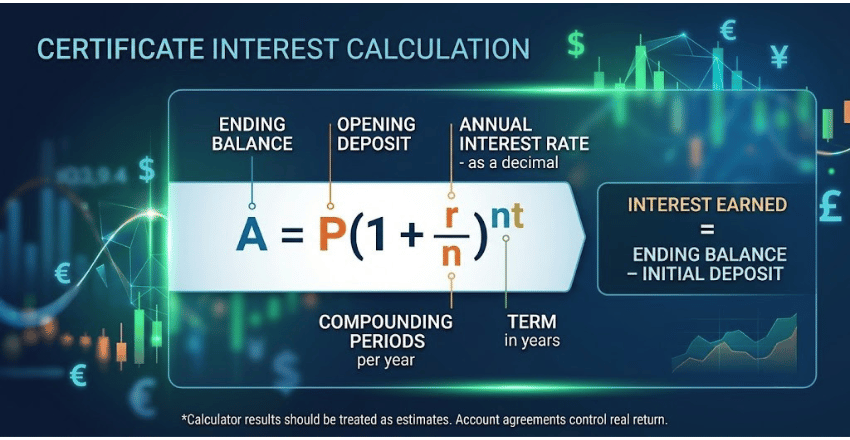
A standard compound-interest formula is:
A = P(1 + r/n)ⁿᵗ
In this formula:
- A is the ending balance.
- P is the opening deposit.
- r is the annual interest rate as a decimal.
- n is the number of compounding periods per year.
- t is the term in years.
To find the interest alone, subtract the opening deposit from the ending balance:
Interest earned = Ending balance − Initial deposit
A quoted APY already reflects compounding over a year. For that reason, an APY-based estimate may use a simplified effective-yield calculation. The institution’s actual crediting method can still affect account statements and the timing of payments.
Calculator results should be treated as estimates. Account agreements control the real return, including the compounding schedule, withdrawal rules, fees, and maturity instructions.
APY Versus Interest Rate
APY and interest rate aren’t always interchangeable.
The interest rate describes the basic percentage applied to the balance. APY reflects the effective yearly return after compounding. This makes APY more useful when comparing deposit accounts with different compounding schedules.
For example, two institutions may advertise the same base rate but compound interest at different intervals. Their APYs may differ slightly. Compare APYs to avoid an inaccurate comparison.
Check the input label before running a calculation. Some tools request APY, while others request the stated interest rate and compounding frequency. Entering APY into a field designed for the basic rate can distort the result.
What the Estimate May Not Include
A basic CD calculator usually assumes a fixed return and no early withdrawal. It may not account for:
- Federal or state income taxes
- Early-withdrawal penalties
- Interest paid into another account
- Broker fees
- Callable or market-linked products
- Changes caused by rounding
- Automatic renewal at a different rate
In the United States, certificate interest is generally taxable unless a specific exclusion applies. Interest may need to be reported even when it remains in the account rather than being withdrawn. Review your tax documents or consult a qualified tax professional for advice tied to your circumstances.
Are Certificates of Deposit Insured?
Deposits held at an FDIC-insured bank are generally covered up to $250,000 per depositor, per insured bank, for each ownership category. The limit applies to the combined deposits held in the same category at that bank, not to each account separately.
Certificates issued by federally insured credit unions may receive similar protection through the National Credit Union Administration.
Verify that the institution is insured before sending money. Also consider the interest that may accrue, since principal and accrued interest count toward the applicable insurance limit.
How to Compare Two Offers
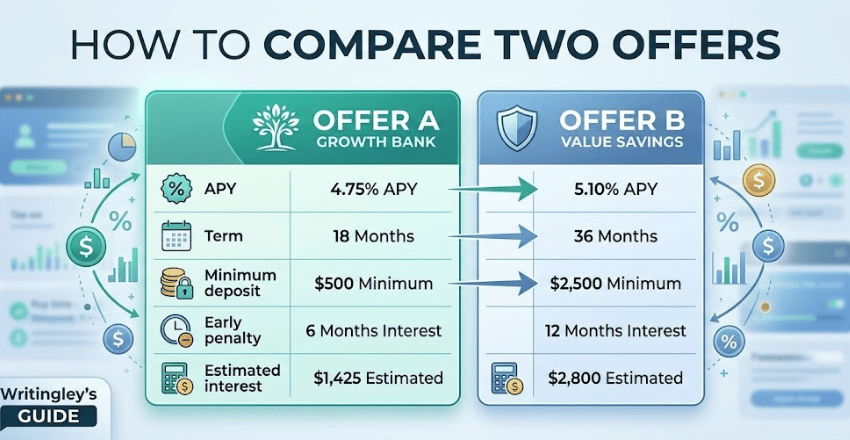
Don’t choose an account based on APY alone. Use this five-point check:
| Factor | Offer A | Offer B |
| APY | Enter advertised yield | Enter advertised yield |
| Term | Record months or years | Record months or years |
| Minimum deposit | Check opening requirement | Check opening requirement |
| Early penalty | Record the stated penalty | Record the stated penalty |
| Estimated interest | Calculate projected return | Calculate projected return |
The higher-paying option may not be the better fit when it requires a longer commitment. Consider when you’ll need the money and whether you already have accessible emergency savings.
Writingley’s guide on tracking your expenses can help you estimate how much cash should remain available. You can also browse the site’s personal finance resources for broader money-planning guidance.
Common Calculation Mistakes
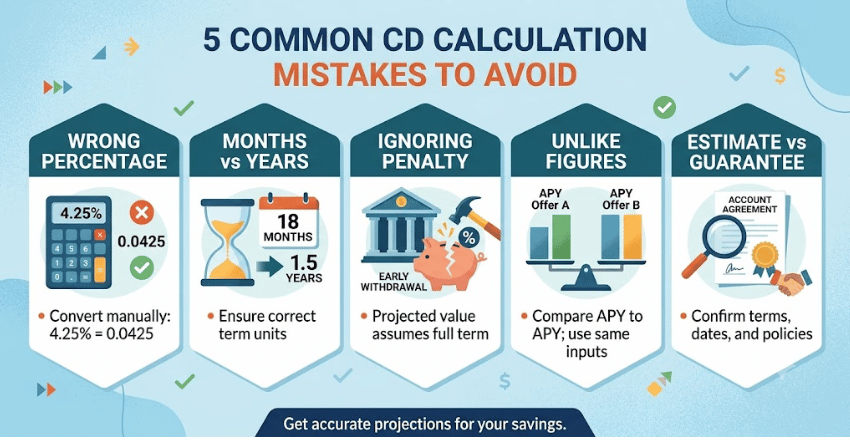
Entering the wrong percentage
Convert the percentage correctly when calculating by hand. A 4.25% rate becomes 0.0425 in the formula, not 4.25.
Confusing months with years
An 18-month term equals 1.5 years. Entering 18 years would create a vastly overstated result.
Ignoring the penalty
The projected maturity value assumes you don’t withdraw early. Check the account agreement for the exact penalty, which may be expressed as a period of interest.
Comparing unlike figures
Compare APYs with the same deposit and term. Changing several inputs at once makes it harder to see which offer provides the stronger return.
Treating an estimate as a guarantee
A calculator can’t override the institution’s account terms. Confirm the rate, deposit requirement, maturity date, renewal policy, and interest-payment method before funding the account.
Frequently Asked Questions
How accurate is a CD calculator?
How much does $10,000 earn in one year?
Does a longer term always pay more?
Can I add money after opening the account?
What happens when the account matures?
Is the interest taxable?
Calculate Before You Commit
Run at least three scenarios before opening an account. Compare the best available rate, a shorter term, and an option that keeps more of your cash accessible.
Then read the institution’s disclosures. Confirm the APY, term, deposit minimum, insurance status, early penalty, and renewal policy. A few minutes of comparison can help you choose a return that fits both your savings target and your timeline.
Calculator outputs are educational estimates and don’t constitute personalized financial, tax, or investment advice.
Conclusion
A CD calculator is a useful tool for estimating how much your certificate of deposit may grow before committing your money to a fixed term. By comparing different deposits, APYs, and maturity periods, you can understand the potential return and choose an option that matches your savings goals.
However, the highest projected earnings are not always the best choice. Consider your need for liquidity, early withdrawal penalties, taxes, insurance coverage, and renewal terms before opening an account. A higher APY may provide more interest, but a shorter term could offer valuable flexibility if your financial situation changes.
Use the calculator as a planning tool, then confirm the final details with the financial institution. Careful comparison of rates, terms, and account conditions can help you maximize your savings while keeping your money aligned with your long-term financial plans.
If you want to know about Budget Score then visit our Budgeting category.