A budget score is a simple way to measure how well your income, spending, savings, and debt work together. It isn’t the same as a credit score, and no single formula is used by every bank or financial app.
You can calculate your own budget score on a 100-point scale by reviewing five areas: spending control, bill payments, savings, debt management, and planning. The result gives you a practical snapshot of your current habits and shows which area needs attention first.
| Key point | What it means |
| Suggested scoring range | 0 to 100 |
| Main areas measured | Spending, bills, savings, debt, and planning |
| Strong result | 80 points or more |
| Review frequency | Once per month |
| Credit impact | None |
| Main purpose | Identify practical financial improvements. |
Key takeaways
- This score is a personal self-assessment, not an official lending metric.
- Your result matters less than the weak areas it identifies.
- Accurate income and expense figures yield more useful results.
- Reviewing the same categories each month helps you track progress.
- A low result is a starting point, not a permanent financial label.
What Is a Budget Score?
A budget score is a rating of how effectively you manage your available money. It looks beyond whether you have cash left at the end of the month. A useful assessment also considers payment reliability, savings habits, debt pressure, and preparation for irregular costs.
Financial organizations use several related terms. These include financial well-being scores, financial fitness ratings, and budgeting assessments. The Consumer Financial Protection Bureau, for example, offers a ten-question financial well-being tool. HSBC also provides a financial fitness assessment scored out of 100.
These tools don’t all use the same formula. Their shared purpose is to show whether your daily money habits support stability and future goals.
A personal rating can help you:
- Find the main source of financial pressure.
- Measure improvement month over month.
- Set a clear priority instead of changing everything at once.
- Spot problems before they cause missed payments.
- Discuss household finances using objective figures.
For more guides on managing income and expenses, visit Writingley’s budgeting resources.
How to Calculate Your Budget Score
Use the five categories below. Give yourself up to 20 points in each area, for a maximum of 100.
This framework is an educational tool created for personal review. It isn’t a formula used by credit bureaus, lenders, or government agencies.
1. Spending control: Up to 20 points
Start by dividing your total monthly expenses by your take-home income.
Formula:
Monthly expenses ÷ monthly take-home income × 100
Use these suggested ranges:
| Expenses as a share of income | Points |
| 80% or less | 20 |
| 81% to 90% | 15 |
| 91% to 100% | 10 |
| More than 100% | 0 |
Spending less than you earn creates room for savings, debt payments, and unexpected costs. Spending more than your income means you’re drawing from savings or relying on credit.
Use recent bank statements instead of estimates. MoneyHelper recommends gathering payslips, statements, bills, and records from the banking app before completing a spending plan.
2. Bill payment reliability: Up to 20 points
Score your payment habits over the past three months.
| Payment history | Points |
| Every bill paid in full and on time | 20 |
| One late payment, quickly corrected | 15 |
| Several late payments | 8 |
| Missed payments or active arrears | 0 |
Include rent or mortgage payments, utilities, insurance, loans, and credit cards.
Automatic payments can reduce accidental delays. Keep enough money in the payment account, since an automatic transfer won’t help if the balance is too low.
3. Savings and emergency preparation: Up to 20 points
This section measures whether you regularly set money aside and have funds available for unplanned costs.
| Savings position | Points |
| Regular monthly saving plus an emergency fund | 20 |
| Regular saving but a small emergency fund | 15 |
| Occasional saving | 8 |
| No current savings | 0 |
Start with a manageable target. Even a small reserve can prevent a car repair, medical bill, or urgent household expense from being charged to a credit card.
Keep planned expenses separate from true emergencies. Annual insurance premiums, school costs, and holiday spending are predictable. Saving for them through dedicated sinking funds makes monthly cash flow easier to manage.
Writingley’s personal finance section can support broader research on saving and money management.
4. Debt management: Up to 20 points
Look at whether debt payments fit comfortably within your income and whether balances are moving downward.
| Debt position | Points |
| No high-interest debt and payments are manageable | 20 |
| Balances are falling each month | 15 |
| Minimum payments are manageable, but balances remain flat | 8 |
| Payments are unaffordable or frequently missed | 0 |
A person can have debt and still receive a solid result. The key questions are whether payments are affordable, interest costs are controlled, and balances are declining.
List every balance, interest rate, minimum payment, and due date. Then direct additional funds to one account while maintaining required payments on the others.
Credit scores and financial-health ratings measure different things. A credit score focuses mainly on borrowing history, while a financial assessment considers broader habits such as saving and planning. Writingley’s credit education hub covers credit reports and responsible borrowing.
5. Planning and tracking: Up to 20 points
Give yourself points based on how consistently you plan and review your money.
| Planning habit | Points |
| Written plan reviewed every month | 20 |
| Written plan reviewed occasionally | 15 |
| Spending is checked without a complete plan | 8 |
| No tracking or planning | 0 |
Consumer.gov recommends listing expenses, recording monthly income, subtracting expenses from income, and using the result to plan the next month.
Your method doesn’t need to be complex. You can use a spreadsheet, a notebook, a banking app, or an envelope system. Choose the method you’ll maintain.
Understanding Your Result
Add the five category totals and compare your result with this guide.
| Total result | Suggested interpretation | Main action |
| 80–100 | Strong | Maintain habits and work toward long-term goals |
| 60–79 | Stable but improvable | Strengthen the lowest category |
| 40–59 | Financial pressure is present | Reduce expenses and create a recovery plan |
| 0–39 | Immediate attention needed | Prioritize essentials and seek qualified help if needed |
These bands aren’t official ratings. They’re designed to turn financial information into a clear next step.
A result of 58 doesn’t mean you’re “bad with money.” You may have reliable payment habits but little emergency cash on hand. Another person may save regularly while carrying expensive debt. The category totals provide more value than the final number alone.
Example Calculation
Consider someone who brings home $4,000 per month and spends $3,500.
Their expenses equal 87.5% of take-home income, earning 15 points for spending control. They pay every bill on time, so they receive 20 points. They save irregularly and have a small emergency reserve, earning 8 points.
Their debt balances are falling, which adds 15 points. They also review a written plan monthly, adding 20 points.
Total: 78 out of 100
The result falls near the top of the stable range. Savings are the weakest category, so the clearest next step is to automate a monthly transfer into an emergency account.
How to Improve Your Score?
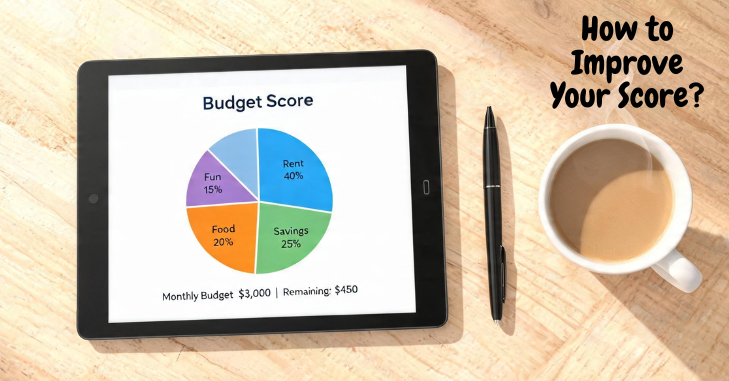
Focus on the lowest category first. Improving one weakness usually works better than attempting five major changes at once.
Track real spending for 30 days.
Review every transaction from your bank accounts and cards. Group purchases into housing, transport, food, debt, subscriptions, savings, and flexible spending.
Don’t judge individual purchases during the first review. Your initial goal is to create an accurate baseline.
Fix a monthly cash-flow gap.
When expenses exceed income, start with costs that can change quickly. Cancel unused subscriptions, compare recurring bills, pause optional purchases, and set weekly limits for flexible categories.
High fixed costs may also require attention, but they often take longer to change.
Automate essential payments
Schedule bills as soon as possible after payday, where possible. Add calendar reminders for payments that can’t be automated.
Review the account before each due date to avoid overdraft fees or rejected transfers.
Build a starter emergency fund.
Choose a small first milestone based on your circumstances. Automate the transfer, even when the starting amount feels modest.
Once you reach the first target, increase it gradually. Consistency matters more than making one large deposit.
Create a focused debt plan.
Choose either the highest-interest balance or the smallest balance as your first target. The highest-interest method can reduce total borrowing costs. The smallest-balance method may provide faster motivational wins.
Keep the strategy that you can follow consistently.
Review progress once a month.
Recalculate the five categories on the same date each month. Keep a record of each result and note what changed.
A rolling review can reduce the impact of a single unusual week or a temporary expense. Some financial-health tools also examine several months of activity for this reason.
Common Scoring Mistakes
Avoid these errors when reviewing your finances:
- Using gross salary instead of take-home income.
- Leaving annual or irregular expenses out of the calculation.
- Treating available credit as income.
- Giving yourself full savings points for unused money that is spent later.
- Ignoring late fees or overdraft charges.
- Comparing your result with someone who has different income and obligations.
- Changing the scoring rules every month.
Use the same method each time. Consistency makes trends easier to understand.
When to Seek Financial Help

Consider speaking with a reputable nonprofit counselor or qualified financial professional when you can’t meet essential payments, use new debt for basic living costs, face collection activity, or don’t understand your repayment options.
Contact lenders early when you expect difficulty. Waiting until several payments are missed can reduce the options available. Be cautious with companies that promise instant debt removal, guaranteed credit improvement, or unusually fast results. Review fees, contracts, and cancellation terms before sharing financial information.
Frequently Asked Questions
Is a budget score the same as a credit score?
What is considered a good result?
How often should I calculate it?
Can my result improve quickly?
Does a high income guarantee a strong result?
Your Next Step
Gather your latest income records, bank statements, bills, debt balances, and savings totals. Score each category honestly, then choose the lowest one.
Set one action for the coming month. That might be canceling two unused subscriptions, automating a savings transfer, or paying an extra amount toward one debt. Recalculate next month and use the change to guide your next decision.