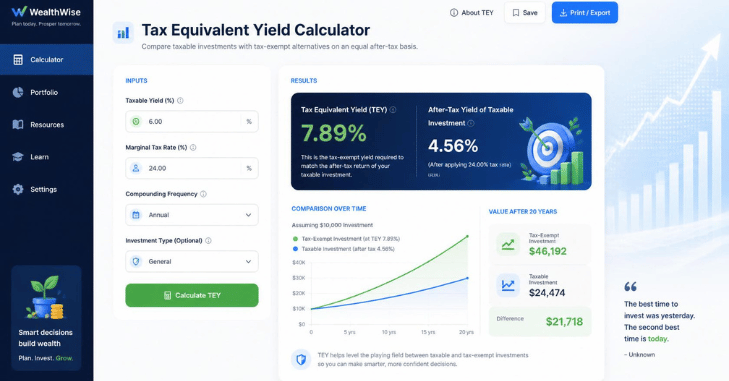
A tax equivalent yield calculator shows the taxable return an investment must earn to match the after-tax income from a tax-exempt municipal bond. Enter the municipal bond’s yield and your marginal tax rate. The result lets you compare tax-free and taxable investments on a more level playing field.
You shouldn’t choose a bond by its advertised yield alone. A taxable bond may display a higher rate but leave you with less income after federal, state, or local taxes.
| Calculator detail | What to enter or review |
| Tax-exempt yield | The municipal bond’s stated annual yield |
| Marginal tax rate | The rate applied to your next dollar of taxable income |
| Calculated result | The taxable yield needed to equal the municipal bond |
| Main use | Comparing municipal and taxable bonds |
| Important limitation | The result doesn’t compare credit, duration, liquidity, or call risk |
Direct answer: Divide the tax-exempt yield by one minus your marginal tax rate. For example, a municipal bond yielding 3.5% has a taxable-equivalent yield of about 4.61% for an investor in the 24% bracket. A comparable taxable bond must yield more than 4.61% to provide a higher after-tax return.
Key Takeaways
- A tax-free yield and a taxable yield aren’t directly comparable.
- Your marginal tax rate has a major effect on the result.
- A higher tax bracket produces a higher taxable-equivalent figure.
- State and local exemptions may increase a municipal bond’s relative value.
- Yield is only one factor. You must also compare risk, maturity, fees, and liquidity.
How Does the Tax Equivalent Yield Calculator Work?
The standard formula is:
Tax-equivalent yield = Tax-exempt yield ÷ (1 − marginal tax rate)
This calculation converts a municipal bond’s tax-free yield into the return required from a fully taxable investment. The same basic formula is used by financial firms and investing resources that provide municipal bond comparison tools.
Suppose a municipal bond yields 3.5%, and your federal marginal rate is 24%.
- Convert 24% to 0.24.
- Subtract 0.24 from 1 to get 0.76.
- Divide 3.5% by 0.76.
- The result is approximately 4.61%.
A taxable bond would need to yield about 4.61% to provide the same income after a 24% federal tax. If a comparable corporate bond yields 4.8%, its after-tax return may be higher. If it yields 4.4%, the municipal bond may provide more income after federal tax.
Why Does Your Marginal Tax Rate Matter?
Your marginal rate is the rate that applies to your next dollar of taxable income. It isn’t necessarily the percentage of your entire income paid in taxes. As the marginal rate rises, a taxable investment loses more of its tax interest.
The tax-free income from a qualifying municipal bond becomes more valuable by comparison.
Here is the same 3.5% municipal yield at several assumed federal rates:
| Marginal tax rate | Municipal yield | Taxable-equivalent yield |
| 12% | 3.50% | 3.98% |
| 22% | 3.50% | 4.49% |
| 24% | 3.50% | 4.61% |
| 32% | 3.50% | 5.15% |
| 37% | 3.50% | 5.56% |
This comparison illustrates why tax-exempt bonds often receive more attention from investors in higher brackets. It doesn’t mean a municipal bond is automatically the better investment.
Federal, State, and Local Taxes

Interest from many qualifying municipal bonds is exempt from federal income tax. A bond issued within your state may also receive state or local tax treatment, depending on the bond and your jurisdiction. Bankrate and Raymond James both note that in-state municipal interest may be exempt from state income tax in some circumstances.
Don’t assume every municipal security has identical tax treatment. Certain private activity bonds may have alternative minimum tax implications, and the tax rules depend on the security and the taxpayer. IRS materials explain that tax-exempt bond status and AMT treatment can vary by bond type.
Use your federal rate alone when the interest is exempt only at the federal level. When state or local exemptions apply, check the bond documents and your state’s rules before adding those rates to your calculation.
Comparing a Municipal Bond With a Taxable Bond
A tax equivalent yield calculator is most useful when the investments have reasonably similar characteristics. Comparing a short-term, highly rated municipal bond with a long-term speculative corporate bond can produce a misleading decision.
Review these factors alongside the calculated yield:
Credit Risk
A higher yield can reflect a greater chance that the issuer will struggle to make interest or principal payments. Compare credit ratings, issuer finances, bond insurance, and the source of repayment.
Maturity and Interest Rate Risk
Longer-term bonds tend to react more strongly to changes in market interest rates. A higher yield may compensate you for taking greater price risk.
Call Provisions
Some issuers can redeem bonds before maturity. An attractive stated yield may not represent the return you receive if the security is called early.
Liquidity and Trading Costs
Individual municipal bonds may trade less frequently than Treasury securities or major bond funds. Bid-ask spreads and brokerage markups can reduce your realized return.
Fund Expenses
A municipal bond mutual fund or exchange-traded fund can provide diversification, but its expense ratio lowers the income retained by investors.
Practical rule: Compare investments with similar credit quality, maturity, call features, and costs. Then use the taxable-equivalent figure to evaluate the tax difference.
A Break-Even Example

Assume you’re considering two investments:
- A tax-exempt municipal bond yielding 4%
- A taxable corporate bond yielding 5.1%
- A federal marginal tax rate of 24%
The municipal bond’s taxable-equivalent return is:
4% ÷ (1 − 0.24) = 5.26%
On yield alone, the municipal security offers the higher tax-adjusted return because 5.26% exceeds 5.1%.
You can confirm the comparison from the opposite direction:
Taxable Bond After-Tax yield = 5.1% × (1 − 0.24) = 3.88%
The corporate bond leaves about 3.88% after federal tax, while the municipal bond provides 4% if its interest qualifies for the assumed exemption.
This example is a starting point, not a recommendation. The corporate bond could have a different maturity, credit rating, call schedule, or market price.
Common Calculator Mistakes
Using your Effective Tax Rate
The formula normally uses the marginal rate affecting the investment income, not the average percentage paid across all income.
Treating Every Municipal Bond As Tax-Free
Confirm whether the bond’s interest qualifies for federal, state, and local exemptions in your situation.
Comparing unlike investments
Similar yields don’t mean similar risks. Match maturity, credit quality, liquidity, and call features before concluding.
Ignoring Purchase Price
A bond bought above or below its face value may have a yield to maturity that differs from its coupon rate. Use the relevant yield from the bond quote rather than relying only on the coupon.
Assuming The Result Predicts Performance
The calculation estimates a tax-adjusted yield from the inputs provided. It doesn’t predict price changes, defaults, reinvestment rates, or future tax law.
When May Tax-Exempt Bonds Be Worth Reviewing?

Municipal bonds may deserve closer review when you:
- Face a relatively high marginal tax rate.
- Want income that may qualify for federal tax exemption.
- Live in the issuing state and may qualify for added state treatment.
- Can hold the bond for an appropriate period
- Understand the issuer’s credit and repayment structure.
- Need fixed-income exposure within a broader portfolio
Tax benefits shouldn’t override investment quality. A lower-risk taxable bond may suit you better than a weak municipal issuer, even when the tax-adjusted calculation favors the municipal security.
Writingley readers planning several financial goals can also use the site’s monthly savings calculator to estimate regular contributions and review its IRA CD guide when comparing retirement-focused deposit products.
For related tax planning topics, see Writingley’s explanation of the Augusta Rule and its guide to the mega backdoor Roth IRA.
Conclusion
A tax-equivalent yield calculator is a simple yet powerful tool for evaluating tax-free municipal bonds against taxable investments on an equal footing. By accounting for your marginal tax rate, it provides a clearer picture of your potential after-tax income and helps you avoid relying solely on advertised yields.
However, yield is only one part of a smart investment decision. Before choosing a bond, compare its credit quality, maturity, call features, fees, and liquidity, and confirm its federal, state, and local tax treatment. Use the calculator alongside thorough research and seek professional tax or financial advice.
Apart from that, if you want to know about the article Mileage Rate 2025, then visit our Taxes category:
Frequently Asked Questions
What does a tax equivalent yield calculator tell you?
What is the formula for taxable-equivalent yield?
Tax-exempt yield ÷ (1 − marginal tax rate)