Non-QM loans provide an alternative for borrowers whose income, credit profile, or property doesn’t fit standard mortgage guidelines. They can help self-employed buyers, real estate investors, retirees, and people with significant assets qualify using different forms of documentation. The added flexibility often comes with higher rates, larger down payments, and stricter lender-specific conditions.
| Key point | What borrowers should know |
| Full name | Non-qualified mortgage |
| Common users | Self-employed borrowers, investors, retirees, and people with nontraditional income |
| Income options | Bank statements, rental cash flow, assets, or other lender-approved records |
| Typical trade-off | Flexible underwriting but potentially higher rates and fees |
| Government backing | Usually not backed by FHA, VA, USDA, Fannie Mae, or Freddie Mac |
| Main protection | The lender generally must still assess the borrower’s ability to repay |
Direct answer: A non-qualified mortgage is a home loan that falls outside the Consumer Financial Protection Bureau’s Qualified Mortgage standards. It doesn’t mean the lender can ignore repayment ability. Instead, the lender may use alternative income records, asset calculations, or property cash flow when evaluating the application.
What Are Non-QM Loans?
A non-qualified mortgage is a residential loan that doesn’t meet all the requirements for Qualified Mortgage status. Qualified Mortgages have restrictions intended to reduce risk and support a borrower’s ability to afford the debt.
The term “non-qualified” describes the loan’s regulatory classification. It doesn’t automatically mean the mortgage is unregulated, fraudulent, or equivalent to a pre-2008 no-document loan.
Most mortgage lenders must make a reasonable, good-faith determination that a borrower can repay the loan. The CFPB says this review generally considers income, assets, employment, credit history, monthly debt, and other expenses.
The difference is how the lender documents and evaluates those factors. A conventional lender may rely on W-2 wages, pay stubs, tax returns, and established agency formulas. A non-QM lender may accept other evidence when those records don’t show the borrower’s full financial position.
Who May Benefit From This Type of Mortgage?
These mortgages are designed for financially capable borrowers who don’t fit traditional underwriting rules.
Self-employed borrowers
Business owners often reduce taxable income through legitimate deductions. That can make their tax returns show less qualifying income than the business generates.
A bank statement program may instead review deposits over a set period. The lender then applies its own method for estimating eligible business or personal income.
Self-employed applicants should organize their finances before applying. Writingley’s guide to tracking expenses can help separate recurring business costs, household spending, and irregular obligations.
Real estate investors
An investor may own several financed properties or report income that changes from year to year. Standard debt-to-income ratios can make it difficult to obtain another conventional mortgage.
A debt service coverage ratio loan may place greater emphasis on the rental property’s expected income. The lender compares qualifying rent with the property’s proposed housing payment.
Borrowers with substantial assets
Some retirees, entrepreneurs, and high-net-worth households have enough assets to support a mortgage but limited monthly employment income.
An asset-depletion program may convert eligible savings or investments into calculated monthly income. The calculation and eligible account types vary by lender.
Borrowers recovering from a credit event.
A bankruptcy, foreclosure, short sale, or serious late payment can create a waiting period for conventional financing. Certain lenders may consider an application sooner when the borrower has rebuilt credit and can make a larger down payment.
Approval isn’t guaranteed. The lender will usually examine the cause of the event, the time since it occurred, and the applicant’s current financial stability.
Common Types of Non-Qualified Mortgages
Programs vary, but several structures appear regularly.
| Loan type | How qualification may work | Often suited to |
| Bank statement loan | Uses eligible deposits instead of standard tax-return income | Business owners and independent contractors |
| DSCR loan | Compares rental income with the property payment | Real estate investors |
| Asset-depletion loan | Converts eligible assets into calculated income | Retirees and asset-rich borrowers |
| 1099 loan | Uses contractor earnings and related documentation | Freelancers and independent contractors |
| Interest-only mortgage | Allows interest-only payments for an initial period | Borrowers with planned or uneven cash flow |
| Recent credit-event program | Considers borrowers before some conventional waiting periods end | Applicants rebuilding after a major credit problem |
Not every product is available in every state. Requirements can also change based on occupancy, property type, loan size, credit score, and lender policy.
Interest-only payments deserve particular care. They may lower the initial payment, but they don’t reduce principal during the interest-only period. The payment can rise when principal repayment begins.
Qualification Requirements to Expect
There is no single national approval checklist for every lender. Still, applicants commonly face several requirements.
Alternative proof of income
Depending on the program, a lender may request:
- Personal or business bank statements
- Profit-and-loss statements
- 1099 forms
- Lease agreements
- Appraisal-based rental estimates
- Brokerage and retirement account statements
- Documentation explaining large deposits
Alternative documentation doesn’t mean no documentation. You may need to provide more records than you would for a standard mortgage.
A meaningful down payment
Borrowers often need more money upfront because the lender takes on additional underwriting and resale risk. Published consumer guidance notes that larger down payments are common with these products.
The required amount depends on the loan purpose, credit profile, property, and documentation method. An investment property may require more equity than an owner-occupied home.
Before applying, compare the down payment with your closing costs and emergency reserves. A home purchase shouldn’t leave you without funds for repairs, taxes, insurance, or income disruptions.
Cash reserves
A lender may require enough liquid assets to cover several months of housing payments. Investment-property programs may require reserves for more than one financed property.
Applicants can use a budget binder to organize statements, recurring bills, savings records, and planned homeownership costs.
Credit and property review
Some programs accept credit profiles that conventional lenders won’t approve. Yet a higher score may still yield better pricing and a smaller down payment requirement.
The property also matters. The lender will usually order an appraisal and assess the property’s condition, marketability, occupancy, and intended use.
Costs, Benefits, and Risks
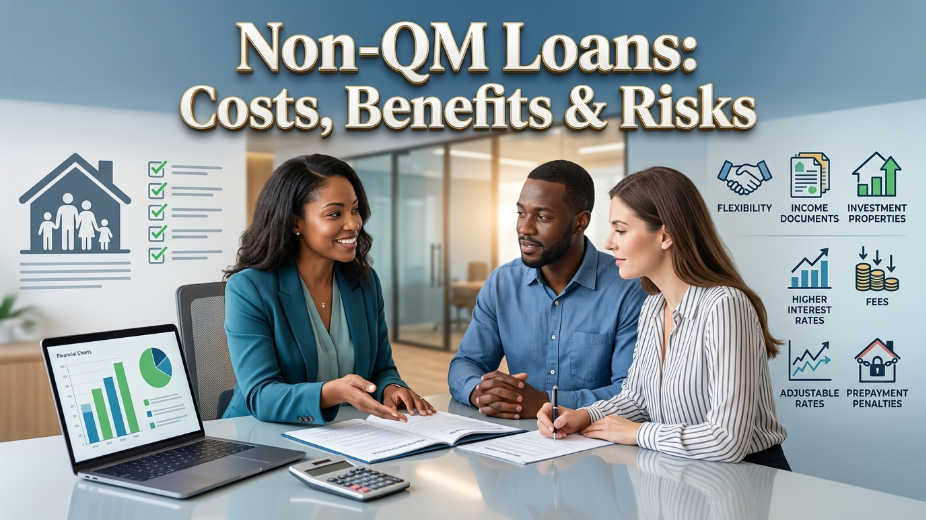
The strongest benefit is flexibility. A borrower may qualify using a financial picture that standard automated underwriting doesn’t capture well.
Other possible benefits include:
- More income-documentation choices
- Options for rental-property investors
- Programs for large or unusual loan amounts
- Consideration after certain credit events
- Loan structures suited to irregular cash flow
The costs can be high. These mortgages may have a higher interest rate, more lender fees, a larger down payment, or a prepayment penalty. CFPB guidance also notes that the points-and-fees limits applying to Qualified Mortgages don’t necessarily protect a loan outside that category.
A lower initial payment may also hide future risk. Ask whether the rate can adjust, whether the payment can rise, and whether the balance will decrease from the first month.
A simple affordability test
Consider a borrower choosing between two $400,000 mortgages.
One loan has a lower rate but rejects the borrower’s income documentation. The second accepts bank statements but costs several hundred dollars more each month.
The second option may still support a planned home purchase. Yet it only makes sense when the borrower can handle the higher payment, maintain reserves, and absorb normal ownership costs.
This comparison shifts the question from “Can I get approved?” to “Can I safely afford the approved loan?”
How to Compare Lenders
Get written estimates from multiple licensed lenders or brokers. Don’t compare the interest rate alone.
Review these items:
- Annual percentage rate
- Interest-rate type
- Monthly principal and interest
- Total cash required at closing
- Origination and underwriting fees
- Prepayment penalties
- Balloon-payment terms
- Interest-only period
- Documentation requirements
- Estimated time to close
Ask each lender to explain why the proposed program fits your situation. A clear answer should connect the documentation method with your actual income, assets, property, and borrowing goal.
You should also confirm whether an application with standard documentation could qualify for a less expensive product. Flexible underwriting is useful, but it shouldn’t replace a cheaper mortgage when you meet conventional requirements.
Questions to Ask Before Applying
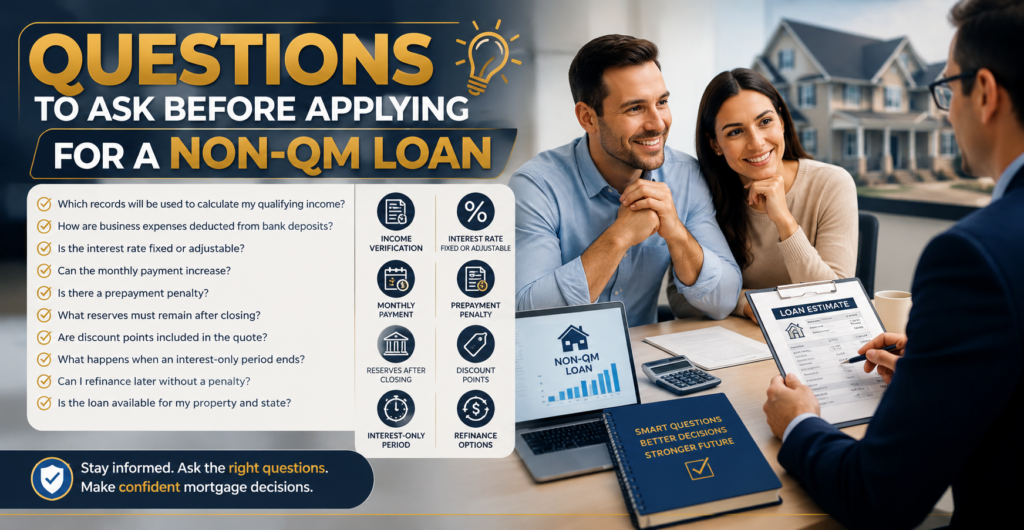
Ask the lender or broker:
- Which records will be used to calculate my qualifying income?
- How are business expenses deducted from bank deposits?
- Is the interest rate fixed or adjustable?
- Can the monthly payment increase?
- Is there a prepayment penalty?
- What reserves must remain after closing?
- Are discount points included in the quote?
- What happens when an interest-only period ends?
- Can I refinance later without a penalty?
- Is the loan available for my property and state?
Keep each quote, loan estimate, and disclosure in one place. Review the final figures against your monthly spending plan rather than relying only on the approved amount.
Frequently Asked Questions
Are non-QM loans the same as subprime mortgages?
Do you need tax returns to qualify?
Are rates higher?
Can you refinance later?
Are these mortgages safe?
Decide Based on Affordability, Not Approval Alone
Nontraditional mortgage financing can create a practical route to homeownership or property investment. It works best when alternative documentation reflects genuine, dependable financial capacity.
Compare several lenders, read every loan feature, and calculate the full cost over your expected ownership period. Review your monthly cash flow through Writingley’s personal finance resources before committing.
A mortgage approval tells you what a lender will finance. Your budget, reserves, and long-term plans determine whether accepting it is the right decision.
Conclusion
Non QM loans can provide valuable opportunities for borrowers who don’t fit traditional mortgage requirements, including self-employed professionals, investors, retirees, and those with complex financial situations. By allowing alternative documentation methods such as bank statements, asset calculations, or rental income analysis, these loans offer flexibility that conventional mortgages may not provide.
However, flexibility often comes with additional costs and responsibilities. Higher interest rates, larger down payments, stricter lender requirements, and unique loan features should be carefully reviewed before making a decision. Borrowers should focus on long-term affordability, repayment ability, and financial stability rather than approval alone.
If you want to know about Mortgage Loan Lenders then visit our Loans category.