


A practical target is 10% of the price for a used vehicle or 20% for a new vehicle. Still, the right answer to how much down payment for a car depends on your savings, credit, loan rate, trade-in value, and monthly budget. Never empty your emergency fund to reach a percentage.
| Key detail | Practical guidance |
| Common target for a new vehicle | About 20% |
| Common target for a used vehicle | About 10% |
| Minimum required | Depends on the lender and your credit |
| Can a trade-in count? | Yes, its net equity can count |
| Main benefit | A smaller loan and lower monthly cost |
| Main risk of paying too little | Owing more than the vehicle is worth |
| Main risk of paying too much | Leaving yourself without cash reserves |
Direct answer: Aim for 20% upfront on a new vehicle or 10% on a used one when your budget allows. A smaller amount may still qualify, but you will borrow more and may pay more interest. Keep enough savings for emergencies, registration, insurance, maintenance, and other ownership costs.
How Much Down Payment for a Car Is Enough?
There is no universal amount that every buyer must pay. Experian and Equifax describe 10% to 20% as a typical range when deciding how much down payment for a car. The Consumer Financial Protection Bureau explains that paying more upfront reduces the amount you need to finance. It may also help you receive a lower interest rate.
For a new vehicle, 20% is a useful target because new cars can lose value quickly. A strong initial contribution lowers the chance that your loan balance will exceed the vehicle’s value. This situation is known as being underwater or upside down.
For a used vehicle, 10% may provide a reasonable starting point. Used vehicles have already experienced part of their early depreciation. Their age, mileage, condition, and market value still affect the lender’s decision. Treat these percentages as planning targets rather than strict rules. Your lender may accept less, require more, or offer financing without any cash up front.
New-Car and Used-Car Examples
The dollar amount becomes easier to understand when you apply the percentage to an actual purchase price.
| Vehicle price | 10% upfront | 15% upfront | 20% upfront |
| $20,000 | $2,000 | $3,000 | $4,000 |
| $30,000 | $3,000 | $4,500 | $6,000 |
| $40,000 | $4,000 | $6,000 | $8,000 |
| $50,000 | $5,000 | $7,500 | $10,000 |
Suppose you buy a $30,000 new vehicle and contribute $6,000. Deciding how much down payment for a car you provide changes your starting balance. If you put forward $3,000 instead, the starting balance would rise to about $27,000.
If you put forward $3,000 instead, the starting balance would rise to about $27,000. That difference affects your monthly bill and the interest paid over the life of the loan. The calculation is simple:
Vehicle price − cash contribution − net trade-in equity = amount financed before taxes and fees
Your contract may include sales tax, title charges, registration costs, warranties, or dealer products. Ask for an itemized purchase order before comparing offers.
How a Larger Upfront Amount Helps?

A larger initial contribution when determining how much down payment for a car can improve your loan in several ways:
You borrow less
The immediate benefit is a smaller principal balance. Interest is calculated using the amount borrowed, so reducing that balance can lower your total financing expense.
Your monthly bill may fall
A smaller loan usually produces a lower monthly obligation when the rate and term remain unchanged. The CFPB confirms that a larger upfront contribution can reduce both the monthly payment and the total financing cost.
You may qualify for better terms
Lenders consider credit history, income, debts, loan size, and the initial contribution when pricing an auto loan. A stronger application may qualify for a lower annual percentage rate, although approval is never guaranteed.
You reduce negative-equity risk
Lenders use the loan-to-value ratio to compare the amount borrowed with the vehicle’s value. A lower ratio creates a larger ownership cushion and reduces the risk of owing more than the car is worth.
When Putting More Money Down Is Not the Best Choice
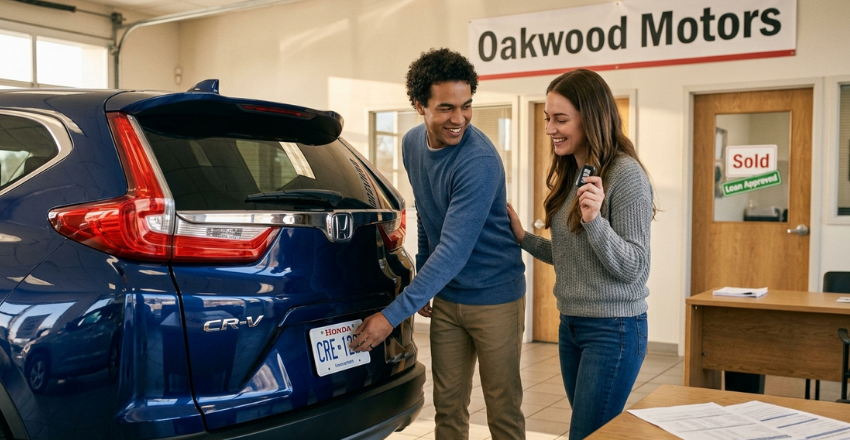
Paying more upfront when evaluating how much down payment to make on a car is not automatically the smartest decision if it consumes nearly all your cash. Keep money available for:
- Insurance premiums
- Registration and title fees
- Fuel and routine maintenance
- Tires or unexpected repairs
- Medical bills and household emergencies
- Several months of essential expenses
A $6,000 contribution may look responsible. It becomes risky when it leaves only $200 in your bank account.
Before committing cash, review your recent spending with Writingley’s guide to tracking expenses in seven steps. This gives you a clearer picture of how much room your budget has for a vehicle.
You can also use a budget binder to record purchase costs, loan payments, insurance, fuel, and maintenance in one place.
Can You Buy a Car with No Money Down?

Some lenders and dealer programs offer zero-down financing. Experian notes that it is possible, although qualifications and terms depend on the buyer and lender. A zero-down offer may help when you need transportation but have limited savings. The tradeoff is a larger balance from the first day.
Possible drawbacks include:
- A higher monthly obligation
- More interest over the loan term
- A higher loan-to-value ratio
- Greater risk of negative equity
- Stricter credit or income requirements
- A need for gap insurance
Do not judge a deal by the amount due at signing alone when deciding how much down payment for a car is right for you. The CFPB recommends shopping with several lenders because the interest rate offered through a dealer may not be the lowest rate you qualify for. Rates and other financing terms may also be negotiable.
Does a Trade-In Count?

Yes. The net equity in your current vehicle can act like cash toward the purchase. For example, assume the dealer values your trade at $8,000, and you still owe $3,000. Your net equity is $5,000. That amount can reduce the new loan balance.
The calculation is:
Trade-in value − remaining loan payoff = net trade-in equity
Negative equity works in the opposite direction. If the vehicle is worth $8,000 but you owe $10,000, you have a $2,000 shortfall. Rolling that balance into the next loan increases the amount financed and can leave you further underwater.
Ask the dealer to list these figures separately:
- Purchase price of the next vehicle
- Trade-in allowance
- Existing loan payoff
- Net trade equity
- Taxes and fees
- Final amount financed
Keeping the figures separate makes it harder for a favorable number in one area to hide an expensive number elsewhere.
How to Choose the Right Amount?

Use this process before visiting a dealership.
- Set the full transportation budget: Keep total costs near 10% to 15% of take-home income.
- Protect your emergency savings: Choose an amount that leaves a reserve.
- Compare several percentages: calculate how much car down payment you can afford using 5%, 10%, 15%, and 20% models.
- Get preapproved: Compare APRs from multiple lenders.
- Avoid stretching the term: Focus on the total cost, not just the monthly bill
Review your credit balances before applying. Writingley’s explanation of statement balance versus current balance can help you understand what is currently owed and what is due.
A Simple Decision Framework
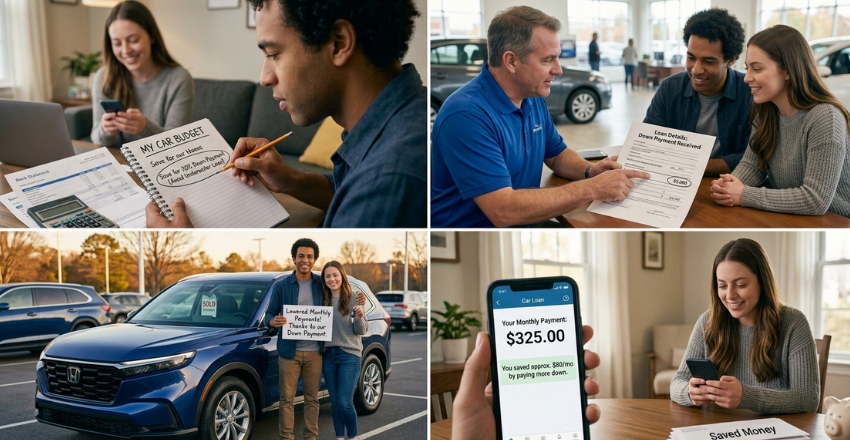
Choose the largest initial contribution that meets all four conditions:
- It leaves your emergency reserve intact.
- It covers taxes, insurance, and registration.
- It creates an affordable monthly obligation.
- It does not require high-interest credit card debt.
This framework is more useful than chasing a fixed percentage. A buyer with stable savings may comfortably provide 20%. Another buyer may be safer at 10% while retaining cash for housing, health care, and repairs.
The vehicle price matters as much as the amount paid upfront. When 20% would drain your savings, and 10% still creates an unaffordable bill, the better answer may be a less expensive vehicle.
Make the Purchase Fit Your Finances
Start with a target of 20% for a new vehicle or 10% for a used one. Then, adjust the figure around your savings and the lender’s terms to settle on the perfect amount for how much down payment for a car. Get at least three financing quotes and compare the total cost, not only the monthly bill. Choose a cheaper vehicle when the purchase would otherwise empty your savings or stretch your budget.
Apart from that, if you want to read an article about Current Mortgage Rates February 2026, visit our Loans category.

