Supplemental Security Income 2026 provides a maximum federal benefit of $994 per month for a single eligible person or $1,491 per month for an eligible couple. The 2026 amounts reflect a 2.8% cost-of-living adjustment. Your payment may be lower if you have countable income or receive certain housing support.
SSI is a federal needs-based program for people with limited income and resources. You may qualify if you are 65 or older, blind, or have a qualifying disability. Unlike Social Security retirement or SSDI, SSI generally doesn’t require a past work record.
| 2026 SSI fact | Amount or rule |
| Maximum for one eligible person | $994 per month |
| Maximum for an eligible couple | $1,491 per month |
| Essential-person amount | $498 per month |
| 2026 cost-of-living adjustment | 2.8% |
| Individual resource limit | $2,000 |
| Couple resource limit | $3,000 |
| Usual payment date | First day of the month |
| Work history required | No |
Direct answer: SSI pays eligible people with low incomes and limited resources up to $994 per month in 2026. An eligible couple can receive up to $1,491. Eligibility depends on age, blindness or disability, income, resources, citizenship status, and living arrangements. State supplements may increase the total payment.
Key takeaways
- The federal maximum rose from $967 to $994 for an individual in 2026.
- An eligible couple can receive up to $1,491 per month.
- The resource limits remain $2,000 for an individual and $3,000 for a couple.
- Countable income can reduce the monthly benefit.
- Some states add a supplemental payment.
- SSI is usually paid on the first day of each month.
Supplemental Security Income 2026 payment amounts
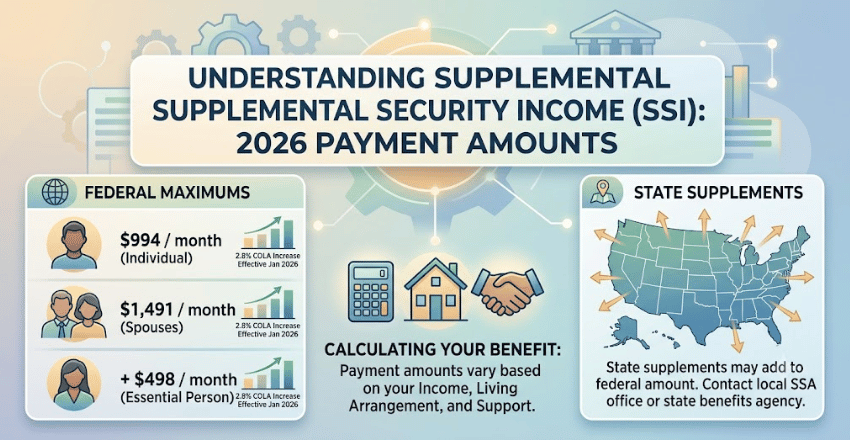
The federal maximum is $994 per month for an individual. Two eligible spouses can receive up to $1,491. An essential person may qualify for an additional federal amount of $498. An essential person is someone who lives with an eligible recipient and provides necessary care.
These figures are maximums, not guaranteed payments. The Social Security Administration calculates your benefit after reviewing your countable income, household arrangements, and certain support you receive.
The 2.8% adjustment increased the individual maximum by $27 from the 2025 rate of $967. The couple’s rate increased by $41 from $1,450. The higher amounts took effect in January 2026, with the first adjusted SSI payment issued on December 31, 2025.
Some states provide extra money on top of the federal benefit. The amount and administration method vary by state. Contact your local Social Security office or state benefits agency to check whether a supplement applies where you live.
Who can qualify for SSI in 2026?
You must have limited income and resources. You must also fall into at least one qualifying group:
- You are age 65 or older.
- You are blind under Social Security’s rules.
- You are an adult with a qualifying disability.
- You are a child with a qualifying disability.
For adults, the medical condition must generally prevent substantial work. It must be expected to last at least 12 months or result in death. Children are assessed under a separate disability standard.
Applicants must also meet citizenship or qualifying noncitizen rules. Certain noncitizens can receive benefits, but eligibility depends on immigration status and other factors.
SSI and Social Security retirement benefits aren’t the same. Retirement and SSDI benefits depend mainly on a person’s earnings record and work credits. SSI is funded from general federal revenues and focuses on financial need.
Income limits and how earnings affect your check
There isn’t one simple income limit that applies to every applicant. Your limit can depend on the type of income, household size, living arrangements, and state supplement.
Social Security separates income into several categories:
- Earned income: Wages and net earnings from self-employment.
- Unearned income: Pensions, Social Security benefits, gifts, and certain other payments.
- In-kind support: Shelter provided by another person.
- Deemed income: Part of a spouse’s, parent’s, or sponsor’s income attributed to you.
Not every dollar counts. Social Security applies exclusions before calculating the payment. In general, higher countable income results in a smaller SSI check. Benefits may stop when countable income exceeds the applicable limit.
An SSA eligibility guide lists general 2026 screening figures below $2,073 in monthly wages for an individual and below $3,067 for a couple. These aren’t universal cutoffs because exclusions and personal circumstances can change the result.
Working doesn’t always end eligibility. The program excludes part of earned income, and several work incentives help recipients return to employment. Students under age 22 may exclude up to $2,410 of monthly earnings, subject to a $9,730 annual limit in 2026.
What counts toward the SSI asset limit?
Countable resources must generally remain at or below:
- $2,000 for an individual
- $3,000 for a couple
Resources can include cash, bank balances, stocks, bonds, and property that you can convert into money. The limits apply to countable assets, not everything you own.
Common exclusions include:
- The home where you live and its land
- One vehicle used by your household
- Most household goods and personal belongings
- Certain life insurance policies
- Property you cannot use or sell
- Some burial funds and burial spaces
The resource test can create problems when money arrives near the end of a month. Review your bank balance and report changes promptly. Don’t transfer or give away property solely to qualify without first learning the program rules.
For practical planning, Writingley’s guide to tracking your expenses can help you separate regular income from spending. A budget binder may also help you organize benefit notices, bills, medical records, and account statements.
When are SSI payments made in 2026?
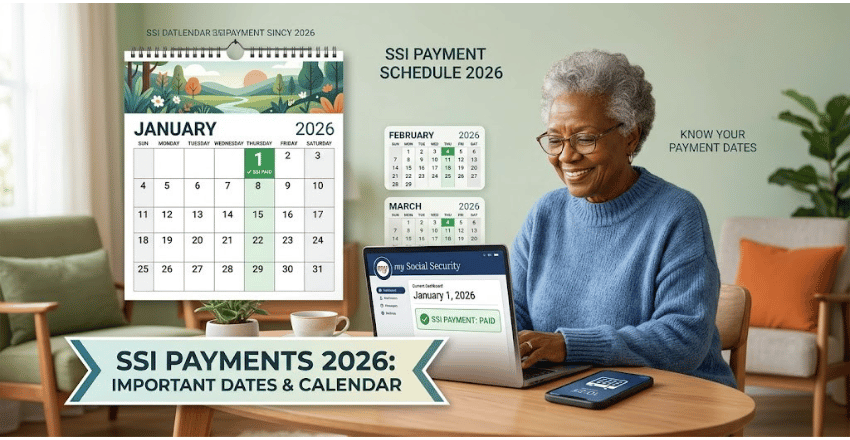
SSI is normally paid on the first day of each month. When the first falls on a weekend or federal holiday, Social Security sends the payment on the preceding business day. An early deposit in the prior month isn’t an extra payment. It is the next month’s benefit arriving early.
People receiving both SSI and Social Security usually receive SSI on the first. Their Social Security benefit is generally paid on the third. Different rules may apply when either date falls on a weekend or holiday.
You can view upcoming payment information through a “my Social Security” account. Contact the agency if a payment is still missing after the waiting period listed on the official calendar.
How to apply
You can begin an application through the Social Security Administration. Depending on your circumstances, you may apply online, call the agency, or schedule an appointment with a local office.
Prepare as many relevant records as possible:
- Social Security number and proof of age
- Citizenship or qualifying immigration documents
- Bank statements and information about other assets
- Pay records, pension statements, and benefit letters
- Housing costs and details about who lives with you
- Medical providers, treatment dates, and medication records
- Work history and school information when applicable
Social Security may not need every document. The agency may accept substitutes or assist in obtaining missing records. Don’t delay the initial application solely because one document is unavailable.
Keep copies of submitted forms and record the date of each call. Store benefit notices with your financial records. Writingley’s retirement resources offer guidance on managing income later in life.
A simple monthly planning example
Suppose an individual receives the full $994 federal benefit and no state supplement. The person could begin with a basic spending plan:
| Category | Planned amount |
| Housing contribution | $450 |
| Food and household needs | $225 |
| Utilities and phone | $110 |
| Transportation | $70 |
| Medical and personal costs | $89 |
| Emergency reserve | $50 |
| Total | $994 |
This example isn’t a recommendation for every household. Housing costs, food assistance, Medicaid coverage, and state supplements can substantially affect the numbers.
A monthly savings calculator can help you test small savings targets. Keep in mind that accumulated cash may eventually count toward the SSI resource limit.
Report changes that may affect eligibility
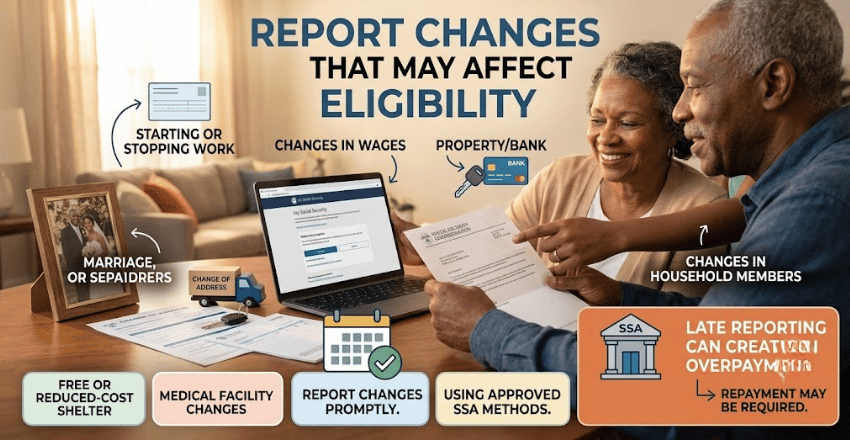
Recipients must report changes that could alter eligibility or payment amounts. Examples include:
- Starting or stopping work
- Changes in wages or other income
- Changes in bank balances or property
- Marriage, divorce, or separation
- Moving to a different address
- Changes in household members
- Receiving free or reduced-cost shelter
- Entering or leaving a medical facility
Report changes promptly using an approved SSA method. Late reporting can create an overpayment. If that happens, Social Security may ask you to repay benefits received in error.
If you want to know about Private Annuity then visit our Retirement category.
Frequently asked questions
How much does Supplemental Security Income pay in 2026?
Did the asset limit increase in 2026?
Can you receive SSI and Social Security together?
Can you work while receiving SSI?
Is SSI taxable?
What should you do next?
Conclusion
Supplemental Security Income 2026 continues to provide essential financial support for eligible individuals with limited income and resources. With a maximum federal payment of $994 per month for an individual and $1,491 for an eligible couple, the program helps older adults, blind individuals, and people with qualifying disabilities meet basic living expenses. However, actual payments depend on income, assets, living arrangements, and other eligibility factors.
Understanding SSI rules, payment amounts, resource limits, and reporting responsibilities can help recipients avoid payment issues and manage their benefits more effectively. If you believe you may qualify, reviewing your financial records, gathering required documents, and applying through the Social Security Administration can be the first steps toward receiving available assistance.
If you want to know about Private Annuity then visit our Retirement category.