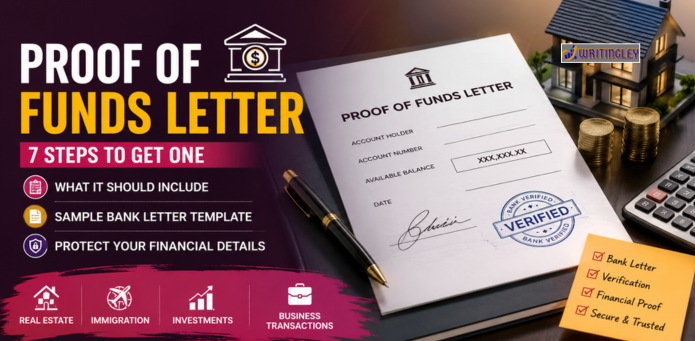
A proof of funds letter confirms that you have sufficient available funds to complete a purchase or meet another financial requirement. Banks and other financial institutions commonly issue these letters for property deals, immigration applications, investments, and large business transactions.
The document doesn’t promise that you’ll spend the money. It verifies that qualifying funds were available in your account on a stated date. Recipients use this verification to confirm your financial capacity at the time the letter was issued, not to guarantee future account balances or transactions.
| Key detail | What it means |
| Main purpose | Confirm that sufficient accessible funds exist |
| Typical issuer | A bank, credit union, brokerage, or other financial institution |
| Common uses | Real estate, immigration, investments, and business transactions |
| Main information | Account holder, institution details, balance, date, and authorization |
| Typical processing time | Same day to several business days |
| Privacy concern | Account numbers and balances should be disclosed carefully |
| Not the same as | Mortgage preapproval, loan approval, or source-of-funds evidence |
Direct answer: A proof of funds letter (POF letter) is an official document from a bank or financial institution confirming that an individual or business has sufficient available funds for a specified transaction. It usually identifies the account holder, the institution, the available balance, the verification date, and an authorized representative.
Key Takeaways
- Ask the receiving party what format and date range it accepts.
- Request the document directly from each institution holding your money.
- Make sure the available balance covers the required amount.
- Keep records showing where recent deposits or transfers came from.
- Share only the financial details needed for the transaction.
- Don’t create, alter, or purchase an unsupported verification document.
What Is a Proof of Funds Letter?
A POF letter is written evidence that an individual or organization controls enough liquid assets for a planned transaction. A financial institution normally prepares it on official letterhead. In real estate, the document can show a seller that a cash buyer has money available to close.
A financed buyer may also need evidence of the down payment, closing costs, or required reserves in the form of a proof of funds letter. Bankrate notes that sellers and lenders may request this evidence from both mortgage borrowers and cash purchasers. The same general concept appears in immigration programs, where funds letter requirements can be more detailed depending on the specific program or authority.
Canada’s Express Entry guidance, for example, calls for official bank letters containing account information, current balances, opening dates, debts, and six-month average balances. Because requirements differ, don’t assume one document works for every recipient. Ask for written instructions before contacting your bank.
What Information Should the Letter Include?

A standard bank verification should contain enough information to establish three facts:
- The document came from a real financial institution.
- The named person or business controls the account.
- The required money was available on the verification date.
Common details include:
- The bank or institution’s name
- Its physical address and contact information
- The account holder’s legal name
- The document’s issue date
- The available or combined account balance
- A partially masked account number
- The currency used
- The name, title, and signature of an authorized employee
- A bank stamp or reference number, when required
For property purchases, Rocket Mortgage lists the institution’s name and address, account balances, the verification date, and an authorized signature among the usual elements. A recipient may ask for more. Immigration authorities might require average balances, outstanding debts, and account-opening dates. A commercial transaction could require wording tied to a specific purchase.
Should the Exact Balance Appear?
Ask the recipient whether the letter must show the full balance or only confirm that your available funds exceed a stated amount. Suppose you have $650,000 but need to demonstrate access to $420,000. Your bank might state that you hold “funds in excess of $420,000,” if the recipient permits that wording. This approach reveals less information while still answering the request.
Which Funds Usually Qualify?

The receiving party decides what it will accept. In many property transactions, qualifying assets must be liquid or capable of becoming cash within the required period. Common examples include:
- Checking account balances
- Savings account balances
- Money market accounts
- Certain brokerage assets
- Proceeds from a completed asset sale
- Documented gifts, subject to lender rules
- Funds from more than one bank
Bankrate identifies checking, savings, certain liquidated investment or retirement assets, gifts, grants, bridge financing, and pending sale proceeds as possible sources that may qualify for a proof of funds letter in mortgage transactions. It also warns that an asset value alone doesn’t make it sufficiently liquid.
Property, vehicles, private-company shares, and personal possessions usually aren’t treated like available cash. Their value may be uncertain, and selling them can take time. When several institutions hold your money, you may need a separate document from each one.
How to Get a Proof of Funds Letter in 7 Steps?
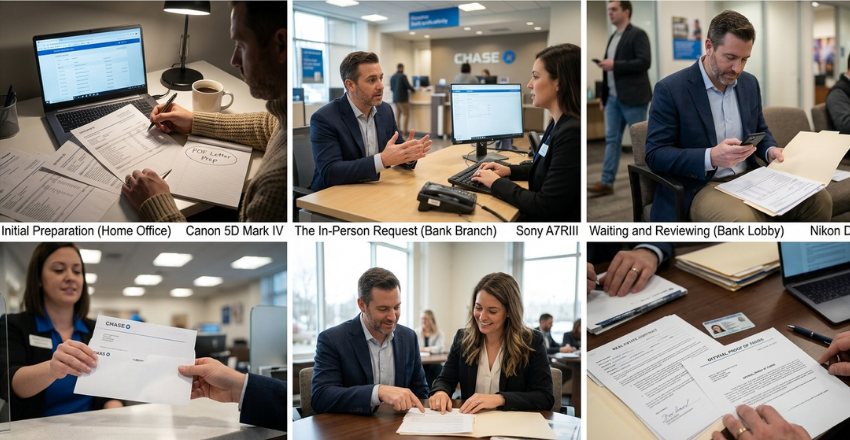
1. Ask What the Recipient Requires
Request a checklist from the seller, lender, agent, immigration authority, school, lawyer, or business requesting the document. Confirm
- The minimum required balance
- The acceptable document date
- Whether statements are also needed
- Whether account numbers may be masked
- Whether electronic copies are accepted
- Whether a specific form or wording is mandatory
This step prevents you from ordering the wrong document.
2. Calculate the Amount You Must Show
Include the complete financial requirement, not only the headline purchase price. For a financed home purchase, that amount might include the down payment, closing costs, and reserves. A cash offer may require enough accessible money to cover the entire purchase and expected transaction expenses.
Writingley’s guide to comparing mortgage loan lenders explains why buyers should review their estimated cash needed at closing alongside rates, fees, and loan terms.
3. Identify the Accounts You’ll Use
List each account that will contribute to the transaction when requesting a proof of funds letter. Check the available balance, ownership name, withdrawal restrictions, and transfer timing. Don’t move money between accounts without preserving the records. Large unexplained deposits can trigger additional questions during mortgage underwriting or other financial reviews.
4. Contact the Financial Institution
Use your bank’s secure message center, telephone service, branch, or business-banking contact. You can use this request:
“Please provide an official bank verification on institutional letterhead confirming that I hold accessible funds of at least [amount and currency] as of [date]. Please include my legal name, the institution’s contact information, a masked account reference, and the name, title, and signature of an authorized representative.”
5. Review the Document Carefully
Check every detail before sharing it:
- Is your legal name correct?
- Does the balance meet the requirement?
- Is the issue date recent enough?
- Is the currency stated?
- Does the letter identify the institution?
- Is an authorized person named?
- Are account numbers masked as permitted?
- Does it include any recipient-specific wording?
A missing signature or outdated date can delay an otherwise valid submission.
6. Protect Sensitive Information
Send the file through a secure portal whenever possible. Avoid posting it in public listings, open document folders, or group chats. Confirm the identity of the person asking for it. Rocket Mortgage advises treating the document as sensitive because it may contain account details and a physical address. You can also ask whether the recipient will accept:
- A masked account number
- A threshold balance rather than the full balance
- A bank contact for direct verification
- A password-protected file
- A document uploaded through a secure portal
7. Keep the Letter and Supporting Records
Save the original document, your request, related bank statements, and records of transfers. These records can help if a lender asks where a recent deposit originated. They also provide a clean audit trail if the recipient contacts the institution.
Sample Bank Letter Format

The financial institution, not the account holder, should issue the final version.
[Financial Institution Letterhead]
Date: [Month Day, Year]
To: [Recipient or “To Whom It May Concern”]
This letter confirms that [account holder’s legal name] maintains one or more accounts with [financial institution’s name].
As of [verification date], the account holder has accessible funds totaling [balance or approved threshold wording] in [currency]. The referenced account ends in [last four digits].
This confirmation reflects the funds available on the stated date. It does not constitute a guarantee, a commitment to lend, or an obligation to complete a transaction.
Please contact [authorized representative] at [verified contact details] if further confirmation is required.
Sincerely,
[Signature]
[Representative’s name]
[Job title]
[Financial institution]
Treat this as a request model, not a self-certification form. The bank should confirm the wording and issue the document through its normal process.
POF Letter vs. Bank Statement vs. Preapproval
| Document | What it demonstrates | Typical issuer | Main limitation |
| POF letter | Accessible money exists on a stated date | Bank or financial institution | It may not show transaction history |
| Bank statement | Balance plus account activity | Bank or brokerage | It reveals more private information |
| Preapproval | A lender may offer financing under stated conditions | Mortgage lender | It doesn’t prove that cash is already available |
| Source-of-funds evidence | Where the money originated | Banks, employers, buyers, or other documented sources | It can require several supporting records |
A mortgage preapproval and a proof of funds letter serve different purposes. A preapproval concerns potential borrowing, while the bank-issued proof of funds letter confirms existing accessible assets. Rocket Mortgage makes the same distinction between lender-supported financing and money already available to the buyer.
Buyers comparing financing can review Writingley’s guidance on mortgage recasting before committing large amounts of cash.
Common Reasons a Document Gets Rejected

A recipient may reject or question the document when:
- The issue date is too old.
- The balance is below the required amount.
- The account holder’s name doesn’t match the application.
- The institution can’t verify the employee or contact details.
- The document lacks letterhead or authorization.
- Important details have been altered or hidden.
- Recent deposits have no supporting records.
- The money isn’t accessible within the required period.
- The letter addresses the wrong transaction or recipient.
Never edit a bank-issued document to correct a mistake. Ask the institution to issue a revised version.
Your Next Step
Ask the recipient for their exact requirements before ordering the proof of funds letter. Then contact every financial institution holding the money you plan to use. Confirm the required balance, the document date, the accepted format, and whether additional documents, such as bank statements, are needed.
Review the completed letter for the balance, date, name, currency, authorization, and privacy settings. A careful request can reduce follow-up questions without disclosing more financial information than the transaction requires.
Additionally, if you’re interested in learning more about “US Housing Market News Today 2026: Complete July Update on Home Prices, Mortgage Rates, Regional Trends, and Will the Housing Market Crash”, be sure to visit our “Loans” category.