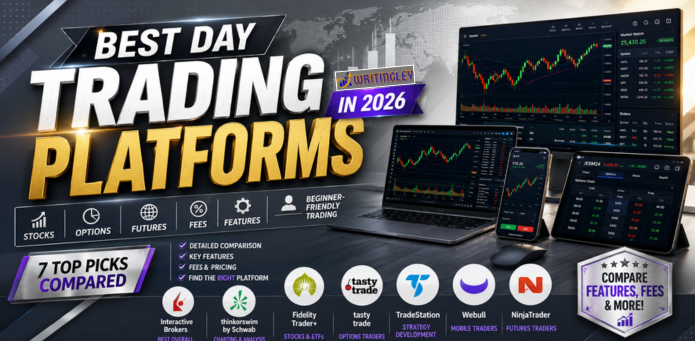
The best day trading platforms combine dependable order execution, useful charts, sensible fees, and tools that match the assets you trade. Interactive Brokers is our top overall pick, while thinkorswim stands out for technical analysis. NinjaTrader is a stronger fit for dedicated futures traders. No broker is ideal for everyone. Your best choice depends on whether you trade stocks, options, futures, or several global markets.
| Platform | Best for | Main strength | Important limitation |
| Interactive Brokers | Best overall | Global market access and low-cost pricing | Trader Workstation has a learning curve |
| thinkorswim by Schwab | Charting and analysis | Advanced desktop, web, and mobile tools | The number of tools may overwhelm beginners |
| Fidelity Trader+ | Stocks and ETFs | $0 online U.S. stock and ETF commissions | Less specialized for futures traders |
| Tastytrade | Options traders | Options-focused workflow and capped commissions | Research tools favor derivatives |
| TradeStation | Strategy development | Customization, charting, and back testing | Advanced features take time to learn |
| Webull | Mobile traders | Accessible app and paper trading | Research depth trails larger brokers |
| NinjaTrader | Futures traders | Futures tools and multiple pricing plans | Not designed as an all-purpose stockbroker |
Direct answer: Interactive Brokers is the strongest all-around choice among the best day trading platforms for active traders who value market access, order types, and competitive pricing. Choose thinkorswim for advanced charts, tastytrade for options, or NinjaTrader for futures. New traders should test each platform in a simulated environment before risking money.
Our Verdict
Interactive Brokers is one of the best day trading platforms and the best overall choice for experienced or developing traders who want access to stocks, options, futures, currencies, and international markets from one account.
Its IBKR Pro pricing can suit high-volume traders, with tiered U.S. stock commissions listed from $0.0005 to $0.0035 per share. IBKR Lite offers $0 commissions on eligible U.S.-listed stocks and ETFs for U.S. residents. Options pricing varies by plan and trading volume.
Pick another broker when your needs are narrower
- Choose thinkorswim for charting and simulated trading.
- Choose tastytrade for an option-centered interface.
- Choose Fidelity Trader+ for active stock trading within a broader investment account.
- Choose NinjaTrader when futures are your primary market.
How We Chose the Best Day Trading Platforms?

We compared the features that have the greatest effect on frequent traders:
- Trading commissions and contract fees
- Order types and execution controls
- Charting, scanners, and technical indicators
- Desktop, web, and mobile availability
- Paper-trading access
- Supported assets and exchanges
- Platform stability and ease of use
- Educational and risk-management tools
A $0 headline commission doesn’t mean every trade is free. Option contract charges, regulatory assessments, exchange fees, market data subscriptions, margin interest, and software plans can increase your total cost when using the best day trading platforms. We also avoided treating one broker as the winner in every category. A stock trader, an options trader, and a futures scalper need different tools.
1. Interactive Brokers: Best Overall
Interactive Brokers offers broad access to global securities and several pricing structures. Its Trader Workstation platform includes advanced order entry, scanners, customizable layouts, and tools for trading across multiple asset classes.
IBKR Pro, one of the best day trading platforms, lists tiered U.S. stock pricing ranging from $0.0005 to $0.0035 per share. Its fixed plan lists a $0.005-per-share rate. Eligible U.S. residents can use IBKR Lite for $0 commissions on U.S.-listed stocks and ETFs.
Pros
- Extensive international market access
- Strong selection of order types
- Competitive rates for active traders
- Stocks, options, futures, bonds, and currencies
- Suitable for traders who may expand into new markets
Cons
- Trader Workstation can feel complex
- Pricing varies by plan, product, and region
- Beginners may need time to configure the interface
Best for: Traders who want professional tools without being limited to one asset class.
2. Thinkorswim by Charles Schwab: Best for Charting
Schwab provides thinkorswim to its clients without a separate platform fee. Standard Schwab trading charges still apply to transactions. The suite includes desktop, browser, and mobile versions.
Chart studies, conditional orders, options analysis, alerts, and customizable workspaces make it a strong research environment. Its Paper Money feature also lets users practice with simulated funds and real-time market data.
Pros
- Detailed charts and technical studies
- Desktop, web, and mobile access
- Paper trading for strategy practice
- Good options-analysis tools
- Platform access has no added charge for Schwab clients
Cons
- Busy interface for first-time users
- Some tools require training before they become useful
- Availability and account features differ by country
Best for: Technical traders who want to analyze and execute from the same workspace.
3. Fidelity Trader+: Best for Stock and ETF Traders

Fidelity Trader+ combines active-trading tools with Fidelity’s wider brokerage and investment services. Fidelity lists $0 commissions for eligible online U.S. stock and ETF trades and no minimum to open a retail brokerage account. Options trades carry contract fees.
The platform suits people who want active stock tools without having to separate trading, retirement, and long-term investments across several firms, making it one of the best day trading platforms for stock and ETF investors. Fidelity continues to support Active Trader Pro Classic while developing the newer Trader+ experience.
Pros
- $0 eligible online U.S. stock and ETF commissions
- Broader research and account services
- No standard retail brokerage account minimum
- Useful for active and long-term holdings
Cons
- Less focused on futures than specialist brokers
- Advanced users may prefer more workspace customization
- Professional trader pricing can differ
Best for: U.S. stock and ETF traders who also maintain long-term investments.
4. Tasty Trade: Best for Options
Tastytrade, one of the best day trading platforms, was built around active derivatives trading. Its interface emphasizes probability, option chains, strategy construction, and position management.
The broker lists a $1 opening commission per contract for stock and ETF options, capped at $10 per leg. Closing commissions are listed at $0 per contract, although exchange, clearing, and regulatory charges may still apply.
Pros
- Options-focused order workflow
- Capped opening commissions on eligible products
- Desktop, web, and mobile tools
- Futures and stock access
- Open API for custom applications
Cons
- Less appealing for research-heavy stock investors
- Fee caps apply per leg, not necessarily per complete strategy
- Derivatives remain complex and risky
Best for: Traders who primarily use listed options and understand multi-leg strategies.
5. TradeStation: Best for Testing Strategies
TradeStation, one of the best day trading platforms, is designed for traders seeking advanced charting, customizable workspaces, scanning, and strategy testing. Its software supports stocks, options, and futures.
The broker promotes commission-free eligible online stock and ETF trading, while options and futures may carry per-contract charges and other fees. Traders should review the current schedule, as pricing can vary by product, account, promotion, and order size.
Pros
- Strong charting and customization
- Strategy testing and automation features
- Stocks, options, and futures
- Built for active trading workflows
Cons
- Steeper learning curve than mobile-first apps
- Data or service charges may apply in some cases
- Automation requires careful testing and monitoring
Best for: Traders who develop rule-based strategies or want detailed workspace control.
6. Webull: Best for Mobile Use
Webull, one of the best day trading platforms, offers a mobile-first experience with charts, watchlists, screeners, access to options, and simulated trading. Its simple account setup and accessible interface can appeal to newer active traders.
The platform is easier to navigate than many professional desktop terminals. That simplicity comes with a trade-off: advanced execution controls, portfolio services, and research may be less extensive than those offered by larger full-service brokers.
Pros
- Accessible mobile and desktop applications
- Paper-trading tools
- Clean watchlists and charts
- Suitable for learning basic order entry
Cons
- Less institutional-style functionality
- Product availability varies by jurisdiction
- Traders must review fees beyond advertised commissions
Best for: Mobile users who value an uncomplicated interface and practice tools.
7. NinjaTrader: Best for Futures
NinjaTrader focuses on futures, including Micro E-mini contracts. Its Free plan lists no monthly subscription and commissions of $0.39 per side for Micro contracts and $1.29 per side for Standard contracts. Monthly and Lifetime plans reduce commissions in exchange for a subscription or one-time payment.
Exchange, clearing, and regulatory fees are additional when using the best day trading platforms. Its charts, depth-of-market tools, automation options, and futures-specific order controls suit traders who don’t need an all-purpose investing account.
Pros
- Built specifically for futures trading
- Free, monthly, and lifetime pricing choices
- Low listed intraday margins on selected contracts
- Strong charting and automation support
Cons
- Extra exchange and data fees may apply
- Low margin can encourage excessive leverage
- Poor fit for long-term stock investors
Best for: Dedicated futures traders who understand contract specifications and leverage.
How to Select the Right Broker?

Start with the market you plan to trade. A feature-rich futures terminal won’t help when you only trade U.S. stocks. Then compare the following costs:
- Commission per share or contract
- Regulatory and exchange assessments
- Margin interest
- Market-data subscriptions
- Platform or routing charges
- Inactivity, transfer, and withdrawal fees
Test the workflow before funding the account. Place simulated market, limit, stop, and bracket orders. Check whether you can adjust or cancel an order without having to search through several menus. You should also examine platform availability during volatile sessions. No broker can guarantee uninterrupted access, so keep the firm’s phone-based trade support details available.
Writingley readers can browse the site’s investing section for future market and investment guides. The broader finance library covers related money topics.
A Simple Platform Scorecard
Give each broker a score from one to five in these categories:
| Category | Weight |
| Execution and order controls | 25% |
| Total trading cost | 20% |
| Stability and support | 20% |
| Charts and scanners | 15% |
| Asset availability | 10% |
| Ease of use | 10% |
Multiply each score by its weight. This prevents a flashy feature from outweighing weak execution, unsuitable assets, or expensive financing. For example, an options trader may give strategy analysis more weight. A futures scalper may increase the weighting for execution and depth-of-market tools.
Day-Trading Rules Changed in 2026
U.S. margin rules changed in June 2026. FINRA replaced the former pattern-day-trader framework and its fixed $25,000 minimum with intraday margin standards. Under the new framework, firms monitor whether account equity is sufficient for intraday exposure.
An account can develop an intraday margin deficit when equity doesn’t support its open positions. FINRA also allowed firms an implementation period, so broker procedures may not change at the same time. Ask your broker which rules currently apply to your account. Cash accounts, margin accounts, futures accounts, and international accounts follow different requirements.
Risks to Consider Before You Start
Day trading can lead to rapid losses, even with the best day trading platforms. Leverage increases both gains and losses, while frequent activity raises the effect of spreads, slippage, and fees. A strong platform can improve order control. It can’t make an unprofitable strategy profitable.
Before using real funds:
- Practice the complete strategy in simulation.
- Set a maximum loss for each trade and each day.
- Avoid using money needed for bills or emergencies.
- Record entries, exits, fees, and mistakes.
- Stop trading when platform behavior or market conditions become unclear.
A monthly savings plan can help separate essential goals from speculative capital. Trading money should remain distinct from emergency savings and near-term expenses.
Take the Next Step
Choose two brokers that support your preferred market from the best day trading platforms. Open their simulated platforms and place the same sample orders on each. Compare speed, chart controls, order entry, risk settings, and the total published cost. Fund an account only after you understand how orders, fees, margin, and withdrawals work.
Keep a trading journal to record your simulated results, execution quality, and mistakes before risking real money. This article is for educational purposes and doesn’t provide personalized investment, tax, or legal advice. Trading involves risk, including the possible loss of principal.
Want to know about Day Trading For Beginners? Check out our Investing category.